

Giving shareholders a voice
Jul 2026
Maura Wyler-Zerboni (Text) Ueli Christoffel (Images)
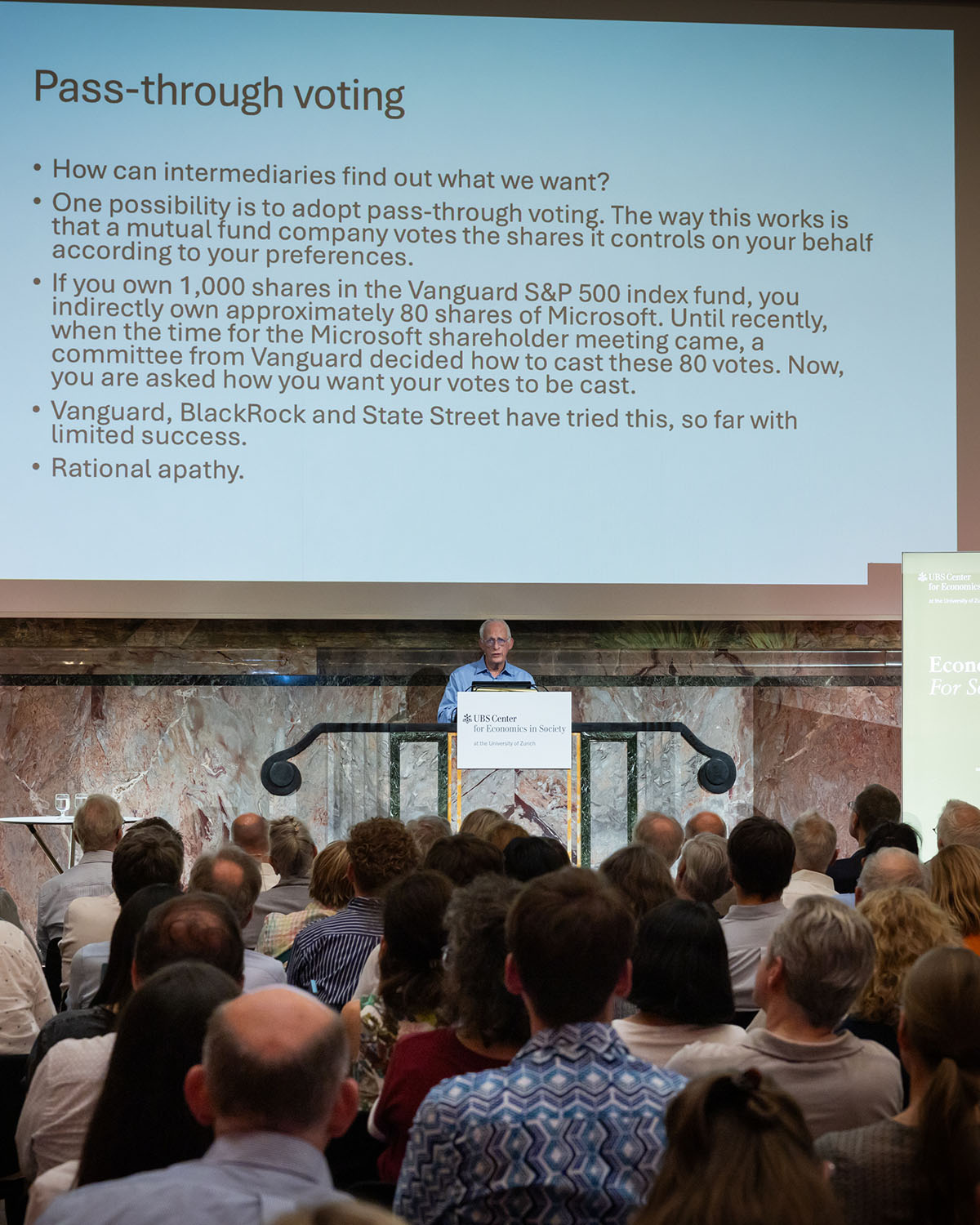
Hart spoke before a packed Aula at the University of Zurich while visiting Zurich for the academic conference held in honor of Ernst Fehr’s 70th birthday. His starting point was deceptively simple: Who decides what companies should do?
The dominant view of corporate governance, shaped by Milton Friedman, holds that companies should maximize shareholder value, while shareholders pursue their social goals independently, for example, by donating part of their dividends to charity. Hart does not reject the principle that companies should act on behalf of shareholders. Instead, he questions a key assumption behind it: that shareholders care only about financial returns. The key difference, Hart argued, is that companies are sometimes uniquely positioned to pursue social objectives themselves.
To illustrate his point, Hart offered the example of a dry-cleaning business that could increase its profits by dumping hazardous chemicals into a nearby river. Friedman’s logic would suggest that shareholders could simply donate part of the higher profits to environmental causes. Hart argued that this misses a crucial point: companies are often uniquely positioned to prevent harm in the first place. Because the company controls the decision that creates the harm, it can often prevent it more effectively than shareholders can compensate for it afterward. In Hart’s words, companies may not have a comparative advantage in giving to charity, “but they do in other activities.”
Hart’s broader argument is that today’s shareholders are not merely investors, they are citizens with social and moral preferences. Yet most never exercise the voting rights attached to their shares. Instead, those votes are cast by a handful of large asset managers on behalf of millions of investors, often without asking what those investors actually want. If shareholders may value more than financial returns, companies and asset managers first need a way to discover those preferences.
His proposed solution is Investor Assemblies, developed jointly with Luigi Zingales and political scientist Hélène Landemore, whose work on citizens’ assemblies inspired the concept. Rather than asking millions of individual investors to vote on every corporate issue, Hart proposes a randomly selected group of investors reflecting the broader shareholder population. Equipped with expert information and balanced briefing materials, they would deliberate together and formulate recommendations on how large asset managers should exercise voting rights on behalf of their clients.
For Hart, the proposal is about more than improving corporate governance. It is about reconnecting corporate decision-making with the preferences of the people who ultimately own companies. By giving ordinary investors a meaningful voice, Investor Assemblies seek to rebalance power between shareholders and the financial intermediaries that currently vote on their behalf.
The ideas presented in Zurich will be explored in greater depth in Hart’s forthcoming book Citizen Investors, co-authored with Luigi Zingales and expected to be published in late 2027.
Maura Wyler-Zerboni (Text) Ueli Christoffel (Images)
Hart spoke before a packed Aula at the University of Zurich while visiting Zurich for the academic conference held in honor of Ernst Fehr’s 70th birthday. His starting point was deceptively simple: Who decides what companies should do?
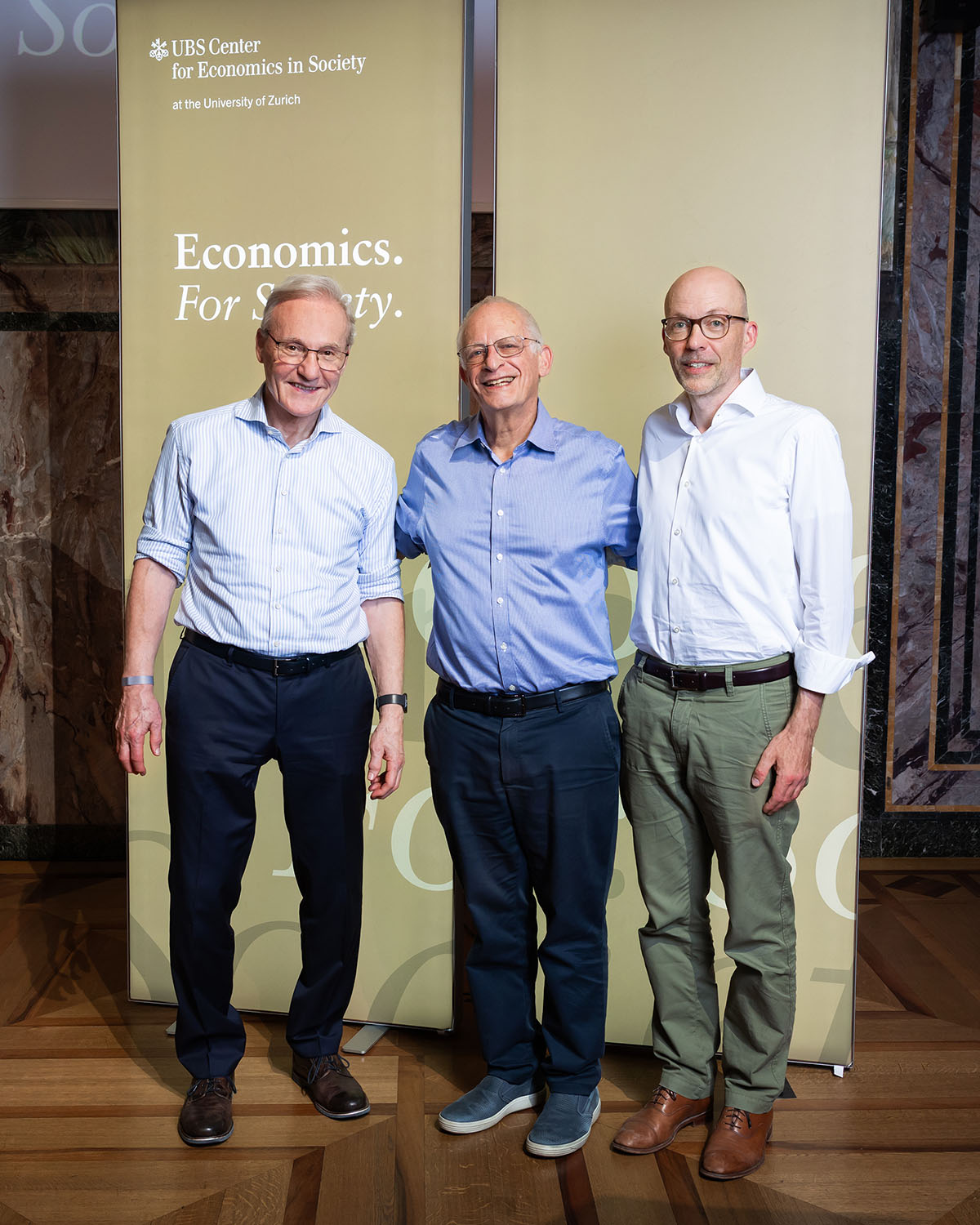
Ernst Fehr has always seen what others missed – the connections between disciplines, the institutions that research needs to thrive, and the partnerships that make lasting impact possible. As he celebrates his 70th birthday, the UBS Center takes this as an opportunity to highlight a career that has shaped behavioral economics as a field, and Zurich’s Department of Economics as a world-class institution. Explore a selection of work, conversations, and tributes that reflect the breadth of his contribution.
Ernst Fehr has always seen what others missed – the connections between disciplines, the institutions that research needs to thrive, and the partnerships that make lasting impact possible. As he celebrates his 70th birthday, the UBS Center takes this as an opportunity to highlight a career that has shaped behavioral economics as a field, and Zurich’s Department of Economics as a world-class institution. Explore a selection of work, conversations, and tributes that reflect the breadth of his contribution.

Sir Oliver Hart is Professor of Economics at Harvard University and one of the world’s most influential economic theorists. He was awarded the Nobel Prize in Economic Sciences for his pioneering contributions to contract theory, which transformed how economists understand the design of institutions, organizations, and corporate governance. His work has shaped research across economics, law, and finance, and has influenced debates on privatization, public-private partnerships, and the governance of firms. In recent years, Hart has turned his attention to a new question: what role investors themselves should play in shaping how corporations respond to today’s major societal challenges.
Sir Oliver Hart is Professor of Economics at Harvard University and one of the world’s most influential economic theorists. He was awarded the Nobel Prize in Economic Sciences for his pioneering contributions to contract theory, which transformed how economists understand the design of institutions, organizations, and corporate governance. His work has shaped research across economics, law, and finance, and has influenced debates on privatization, public-private partnerships, and the governance of firms. In recent years, Hart has turned his attention to a new question: what role investors themselves should play in shaping how corporations respond to today’s major societal challenges.