

Why the multilateral trading system is under strain today
Aug 2026
This is your guide to one of the most consequential forces shaping the global economy. In six lessons, UZH Professor of Economics and former WTO Chief Economist, Ralph Ossa takes you inside the multilateral trading system: how it was built, how it works, where it’s holding, and where it's beginning to crack. The series is based on UBS Center Public Paper #16 The Multilateral Trading System.
The sources of strain in the multilateral trading system are structural rather than episodic. They do not arise from a single economy or dispute, but from a set of shifts that have progressively stretched a system designed to discipline border measures and contain escalation. As trade integration deepened and policy objectives broadened, the gap between the system’s original logic and the problems it is now asked to manage has widened. Four fault lines are particularly important: unresolved development bargains and the legacy of the Doha Round; the rise of China and the return of power politics; the growing salience of sustainability and other cross-border regulatory objectives; and the rapid digitalization of the global economy, where economic change has outpaced multilateral rule-making.
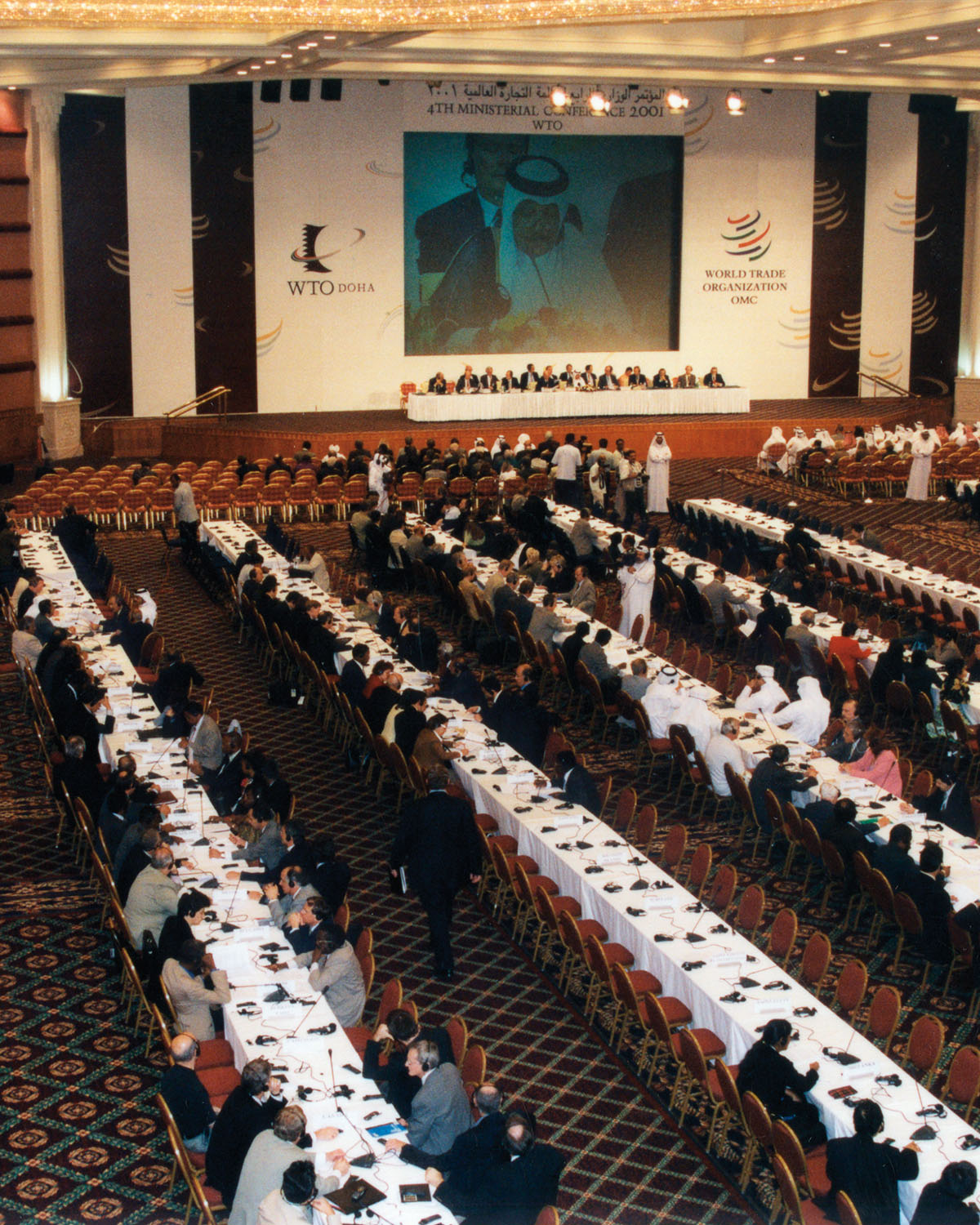
A first and enduring source of strain lies in the multilateral trading system’s unresolved development bargain. The Doha Development Agenda was launched with the explicit aim of rebalancing the system in favor of developing economies – a purpose that has become increasingly obscured as attention has shifted to perceptions of asymmetry elsewhere. Its failure left more than an unfinished negotiating round; it left a set of unresolved distributional and institutional tensions that continue to weigh on the system’s legitimacy and internal cohesion.
Part of the problem lay in the ambition and scope of Doha itself. The agenda attempted to address agriculture, industrial tariffs, services, and developmentrelated flexibilities simultaneously. Expectations among participants were misaligned from the outset, and disagreements over sequencing proved particularly difficult. Economies differed not only on the substance of reforms, but also on who should move first and how adjustment costs should be shared. As negotiations stalled, trust eroded and the round gradually lost its focal role as a platform for reciprocal bargaining.
More importantly, the issues Doha was meant to resolve did not disappear with the round’s collapse. Agriculture remains a central point of contention, reflecting persistent asymmetries in protection and support. Special and differential treatment remains poorly defined, oscillating between demands for broad flexibility and calls for more differentiated commitments. More broadly, disagreements persist over the appropriate balance between policy space and binding commitments, especially for economies at different stages of development.
These tensions are rooted in a deeper structural problem. The multilateral trading system was built around reciprocal bargaining among a relatively small group of advanced economies. When these economies negotiated tariff reductions with one another and extended them on a most-favored-nation basis, developing economies were protected from trade diversion but did not themselves secure additional market access. In a system based on reciprocity, observing others bargain does not generate independent gains.
As a result, meaningful gains require participation in reciprocal commitments. But by the time many developing and emerging economies became central players in global trade, tariff bindings among advanced economies were already low and tightly constrained. This reduced the scope for new reciprocal bargains and made further exchanges of concessions politically and economically more difficult.
A broader tension follows from this logic. Developing economies have consistently emphasized flexibility and policy space within the multilateral system, while the core economic gains from trade agreements arise from binding commitments that reduce uncertainty and secure market access. The instruments designed to accommodate development – greater flexibility and special treatment – have therefore also limited the scope for new bargains capable of delivering substantial gains. This unresolved tension between flexibility and commitment remains a central source of strain in the multilateral trading system.
A second source of strain arises from the rise of China. From an economic perspective, China’s integration into the multilateral trading system stands as one of its greatest successes. WTO accession facilitated an unprecedented expansion of trade, lifted hundreds of millions of people out of poverty, and contributed to rapid convergence between developing and advanced economies. These outcomes are fully consistent with the system’s core objectives and with the gains from trade emphasized earlier.
At the same time, China’s scale and economic model have strained assumptions – often implicit – about how integration into the multilateral trading system would evolve over time. While WTO accession required substantial opening and reform, many members expected deeper integration to be accompanied by a gradual shift toward more market-oriented structures. Instead, China combined deep integration into global markets with extensive state involvement in production, finance, and technology development. As China’s global footprint expanded, questions about the adequacy of existing rules in light of evolving economic realities became increasingly salient.
One dimension of this strain has been the growing entanglement of trade with geopolitics and security. Trade and technology have come to be viewed less as domains governed primarily by efficiency and mutual gain, and more as sources of strategic leverage. Export controls, investment screening, and efforts to reconfigure supply chains reflect a shift toward interpreting interdependence through a security lens. These developments have reintroduced power considerations into a system that was designed precisely to limit their role.
A second dimension concerns distributional conflict within advanced economies. China’s rapid export growth and integration into global value chains generated large aggregate gains, but also imposed concentrated adjustment costs in specific regions and sectors. In some economies, these pressures translated into labor market disruption and political backlash, weakening domestic support for open trade – particularly where adjustment policies proved insufficient. While such challenges are not unique to China, its size and speed of integration amplified their economic and political consequences.
The described rise of China also involves perceptions of an uneven playing field. Persistent concerns have focused on the role of state support, state-owned enterprises, and industrial subsidies in shaping competitive outcomes. Here, the issue is not simply one of compliance, but of coverage. Existing multilateral rules – especially those governing subsidies – have proven ill-suited to an economy of China's scale and institutional structure. This gap between rules and economic reality helps explain both the limits of existing disciplines and the growing resort to unilateral trade measures, particularly by the United States.
Taken together, these developments illustrate how China's rise has both validated and challenged the multilateral trading system. It demonstrated the system's capacity to support growth and convergence on an unprecedented scale. But it also exposed limits in the system's ability to manage power asymmetries, distributional conflict, and state-driven forms of competition. In this sense, China's rise marks the point at which power reentered a system that had been designed to keep it in check.
A third source of strain reflects the growing entanglement of trade with non-trade objectives, particularly in climate policy, environmental sustainability, and corporate conduct. These objectives are economically legitimate and politically salient. The strain arises not from their pursuit as such, but from the way they are increasingly implemented: through unilateral regulatory measures with significant cross-border effects, placing demands on a multilateral trading system that was not designed to arbitrate among competing regulatory goals.
Climate policy provides a prominent illustration. Measures aimed at reducing greenhouse gas emissions – such as carbon pricing and related border measures – have become central to domestic policy agendas. Instruments like the European Union's Carbon Border Adjustment Mechanism seek to address carbon leakage and competitiveness by extending domestic climate policies to imports. While the underlying objective is environmental rather than protectionist, such measures affect market access and relative prices, raising questions about their consistency with existing trade rules and their application across economies with different capacities and responsibilities.
Similar tensions arise in sustainability policies more broadly. Measures targeting deforestation, biodiversity loss, or resource depletion increasingly condition market access on production methods and supply-chain characteristics. These policies respond to genuine global externalities, but they also transmit domestic regulatory choices across borders. From the perspective of trading partners – particularly developing economies – such requirements can resemble new trade barriers, even when motivated by non-trade concerns.
A related set of issues concerns corporate conduct and due-diligence requirements. Rules linked to labor standards, environmental performance, or human rights increasingly apply not only to domestic firms but also to foreign suppliers and affiliates. While these measures pursue well-defined social objectives, they operate through complex regulatory obligations that fragment markets and raise compliance costs. As with climate and environmental measures, the challenge lies less in the legitimacy of the objectives than in the extraterritorial reach of domestic regulatory frameworks and the limited scope for adaptation to diverse regulatory contexts.
Taken together, these developments point to a fundamental tension. The central issue is no longer protectionism versus free trade, but unilateral regulation versus multilateral coordination. As trade becomes more deeply intertwined with domestic regulatory choices, the limits of a system designed primarily to discipline border measures become more apparent. Managing regulatory spillovers without fragmenting markets is therefore a central challenge for the multilateral trading system and a key test of its capacity to adapt to evolving policy priorities.
A fourth source of strain arises where the pace of economic change has been fastest. Digitalization has transformed how trade is conducted, what is traded, and which policies matter most. These changes have expanded the scope of cross-border economic interaction well beyond traditional border measures, placing new demands on a multilateral trading system whose core disciplines were designed for a different set of problems.
As digital trade has grown, attention has shifted toward issues such as cross-border data flows, digitally delivered services, platform regulation, and the use of artificial intelligence. These activities are increasingly central to competitiveness and growth, yet they are shaped primarily by domestic regulatory choices rather than by tariffs or other conventional trade instruments. As a result, the gap between the economic reality of digital trade and the coverage of existing multilateral rules has widened.
The long-standing moratorium on customs duties on electronic transmissions illustrates this gap. By preventing the imposition of tariffs on digital transmissions, the moratorium has helped underpin the early and rapid growth of digital trade by preserving a baseline of predictability. At the same time, it addresses only a single margin of digital trade policy. Other critical challenges in digital trade – data governance, regulatory fragmentation, and access conditions for digital services – remain largely outside the scope of binding multilateral disciplines. Repeated extensions of the moratorium have therefore deferred, rather than resolved, deeper questions about how digital trade should be governed.
These substantive challenges are reflected in the difficulty of advancing cooperation in this area. Preferences over data, privacy, taxation, and industrial policy diverge widely, making it hard to translate shared interests into comprehensive multilateral rules. In response, groups of economies have increasingly pursued cooperation through plurilateral initiatives. Yet resistance from some members – including India – has limited the extent to which such initiatives can be integrated into the multilateral framework, reflecting persistent concerns about policy space, inclusiveness, and fragmentation.
Taken together, digitalization highlights a core tension within the multilateral trading system. The areas where coordination is most valuable are often those where policy instruments are domestic, preferences heterogeneous, and reciprocity hardest to define. As a result, existing multilateral disciplines have struggled to keep pace with rapid technological change. How this tension is managed – without fragmenting markets or undermining predictability – will be central to the system's ability to remain relevant as trade continues to evolve.
In this series, Prof. Ralph Ossa distills his experience from academia and policy making into something rare: a clear, honest assessment of where the system actually stands today. Each lesson offers insights that stand on their own. Follow all six, and you'll come away with a complete picture – and a much sharper understanding of what holds the global economy together, and what happens when it starts to fray.
This is your guide to one of the most consequential forces shaping the global economy. In six lessons, UZH Professor of Economics and former WTO Chief Economist, Ralph Ossa takes you inside the multilateral trading system: how it was built, how it works, where it’s holding, and where it's beginning to crack. The series is based on UBS Center Public Paper #16 The Multilateral Trading System.
The sources of strain in the multilateral trading system are structural rather than episodic. They do not arise from a single economy or dispute, but from a set of shifts that have progressively stretched a system designed to discipline border measures and contain escalation. As trade integration deepened and policy objectives broadened, the gap between the system’s original logic and the problems it is now asked to manage has widened. Four fault lines are particularly important: unresolved development bargains and the legacy of the Doha Round; the rise of China and the return of power politics; the growing salience of sustainability and other cross-border regulatory objectives; and the rapid digitalization of the global economy, where economic change has outpaced multilateral rule-making.

The multilateral trading system is widely perceived to be in crisis, undermined by geopolitical tensions, unilateral trade policies, and growing skepticism toward global cooperation. UZH Professor of Economics Ralph Ossa, who served as Chief Economist of the World Trade Organization (WTO), argues in our latest UBS Center Public Paper, that such narratives are both overstated and insufficiently precise. While the system faces real and structural pressures, it continues to govern the majority of global trade and to deliver significant economic value.
The multilateral trading system is widely perceived to be in crisis, undermined by geopolitical tensions, unilateral trade policies, and growing skepticism toward global cooperation. UZH Professor of Economics Ralph Ossa, who served as Chief Economist of the World Trade Organization (WTO), argues in our latest UBS Center Public Paper, that such narratives are both overstated and insufficiently precise. While the system faces real and structural pressures, it continues to govern the majority of global trade and to deliver significant economic value.

Ralph Ossa, who served as Chief Economist of the World Trade Organization (WTO) from January 2023 to June 2025, took up the UBS Foundation Professorship of Economics at the Department of Economics of the University of Zurich (UZH) as of July 1, 2025. Before joining the WTO, Ralph Ossa was already teaching and conducting research at UZH in the field of international economics, with a particular focus on policy-relevant questions. He was chairman of the Department of Economics from 2019 to 2022 and coeditor of the Journal of International Economics from 2016 to 2022. Prior to Zurich, he was on the faculty at the University of Chicago Booth School of Business. He holds a PhD in Economics from the London School of Economics.
Ralph Ossa, who served as Chief Economist of the World Trade Organization (WTO) from January 2023 to June 2025, took up the UBS Foundation Professorship of Economics at the Department of Economics of the University of Zurich (UZH) as of July 1, 2025. Before joining the WTO, Ralph Ossa was already teaching and conducting research at UZH in the field of international economics, with a particular focus on policy-relevant questions. He was chairman of the Department of Economics from 2019 to 2022 and coeditor of the Journal of International Economics from 2016 to 2022. Prior to Zurich, he was on the faculty at the University of Chicago Booth School of Business. He holds a PhD in Economics from the London School of Economics.