

What the multilateral trading system delivered
Jul 2026
This is your guide to one of the most consequential forces shaping the global economy. In six lessons, UZH Professor of Economics and former WTO Chief Economist, Ralph Ossa takes you inside the multilateral trading system: how it was built, how it works, where it’s holding, and where it's beginning to crack. The series is based on UBS Center Public Paper #16 The Multilateral Trading System.
Judged against its core economic objectives, the multilateral trading system has delivered substantial value over the past three decades. This does not mean that the system is without flaws, nor that it is well suited to all of the challenges it faces today. But it does clarify an essential point for the current debate. The system proved most effective where it disciplined discrimination, stabilized expectations, and contained escalation, allowing economic outcomes to emerge through decentralized decisions within a predictable rules-based framework.
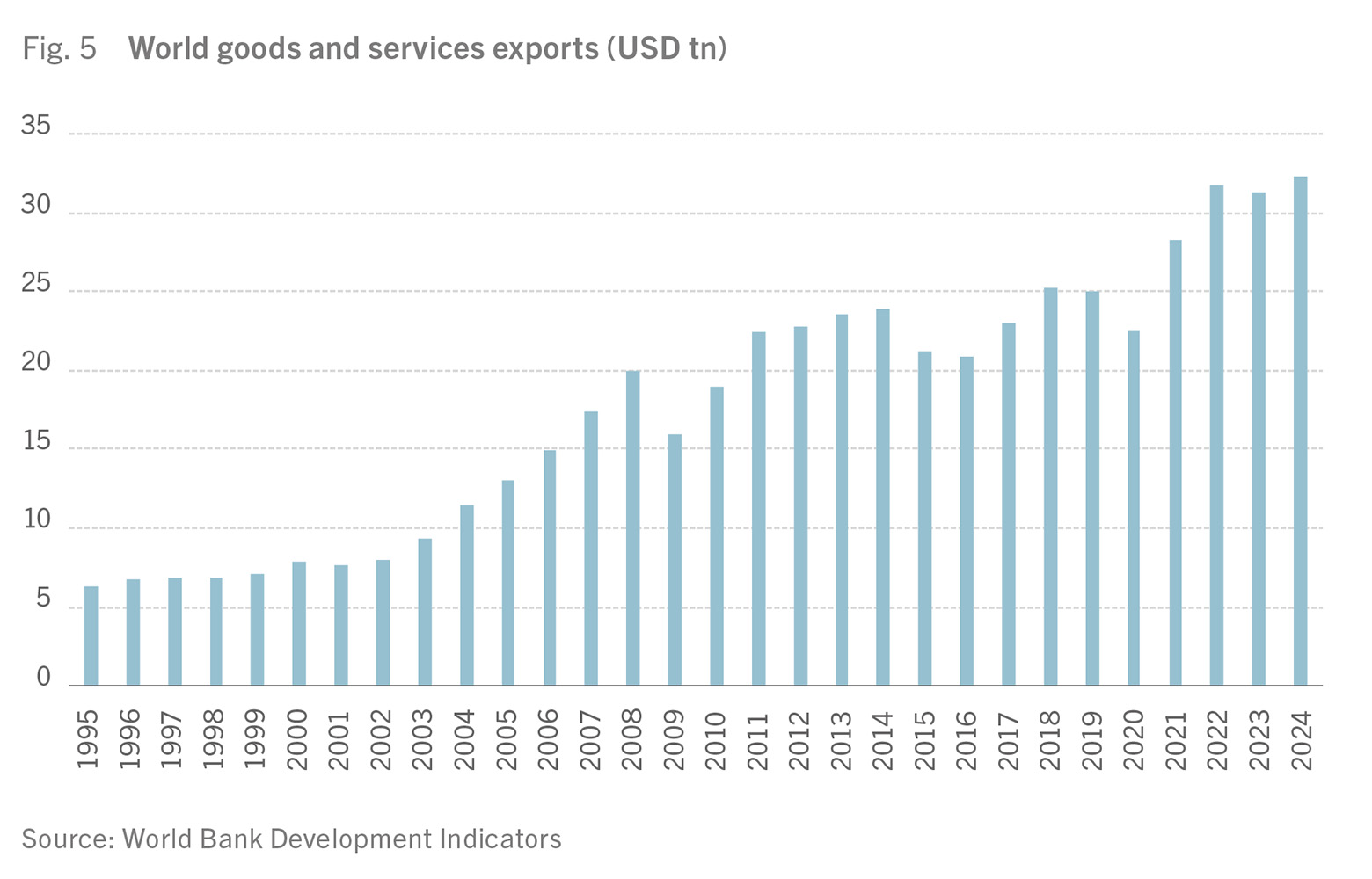
The most visible achievement of the multilateral trading system has been the sustained expansion of global trade since the establishment of the WTO in 1995. Figure 5 shows that over the subsequent three decades, trade in goods and services grew almost fivefold, significantly outpacing global output. This expansion was not confined to a brief liberalization episode. It persisted over an extended period, supporting the deepening of cross-border production networks and large-scale investment.
A key feature of this expansion was that it took place within a rules-based framework. Applied tariffs fell markedly under most-favored-nation treatment, with the average applied MFN tariff declining by more than 40 percent since the mid-1990s. Equally important, tariff bindings and non-discrimination constrained reversals and limited the scope for selective protection. By stabilizing expectations about market access, the system supported long-term investment and integration. Together with broader declines in trade costs, this combination helps explain why trade integration in the WTO era proved both deep and durable.
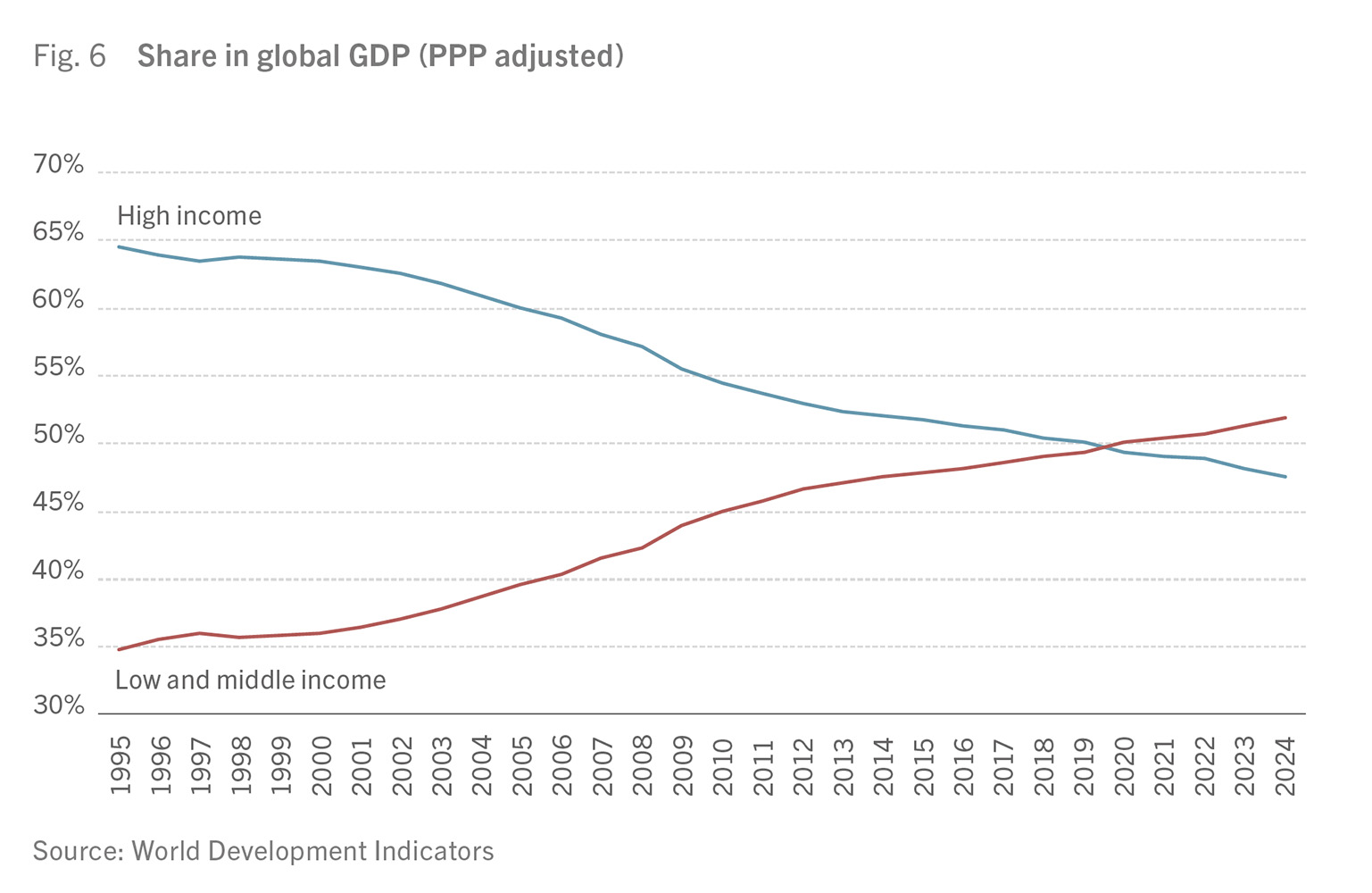
A second major outcome has been the integration of low- and middle income economies into the global trading system. Since the mid-1990s, these economies have increased their share of global trade substantially, including through rapid growth in trade among developing economies themselves (see Figure 6). This period coincided with unprecedented reductions in global poverty and with income convergence between poorer and richer economies, particularly in Asia.
Trade was not the sole driver of these developments. But the multilateral trading system played an enabling role by providing predictable access to foreign markets and constraining arbitrary policy reversals at home. For many developing economies, WTO membership functioned as a commitment device that reduced policy uncertainty and political risk, supporting outward-oriented growth strategies. In this sense, the system’s contribution to convergence lay not only in market access, but in embedding domestic policy choices within a predictable and rulesbased framework.
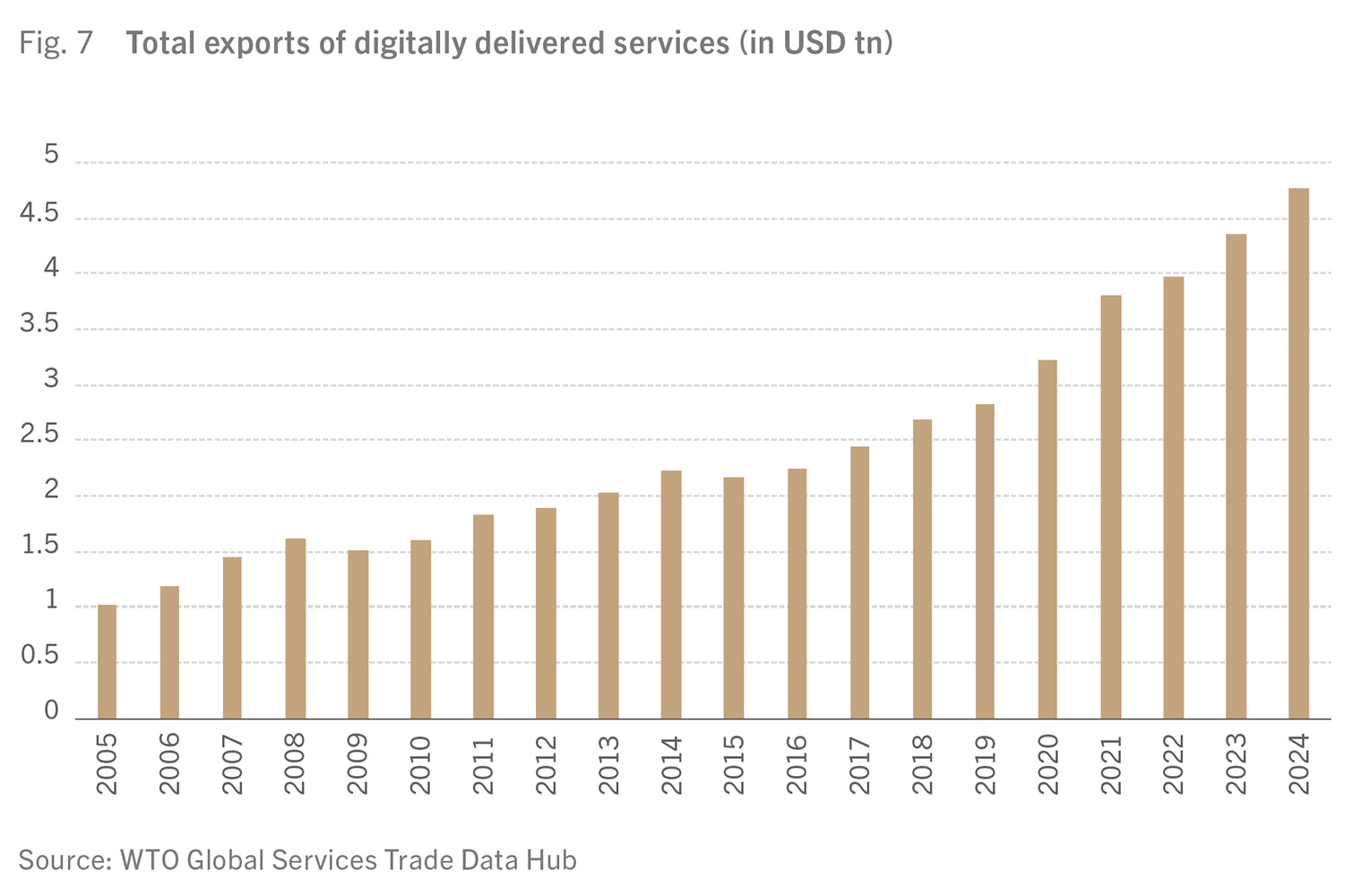
The WTO era coincided with a profound transformation in the structure of global trade. As Figure 7 depicts, services grew steadily in importance, digitally delivered services emerged as a central mode of exchange, and production fragmented across borders as global value chains expanded across goods and services. These changes were driven primarily by technological progress rather than by deliberate trade policy design.
The multilateral trading system did not seek to direct this transformation. Instead, it provided a framework that limited discrimination, reduced border frictions, and stabilized access conditions, allowing firms to reorganize production in response to technological change. Crucially, this adjustment took place without comprehensive harmonization of domestic policies. By constraining the most disruptive forms of policy divergence while leaving substantial scope for national regulation, the system enabled structural change without requiring convergence. This capacity to accommodate far-reaching economic transformation within a flexible, rules-based framework was a key – if often underappreciated – strength of the WTO.
Finally, the system has demonstrated a notable degree of resilience in the face of major shocks. Global trade contracted sharply during the global financial crisis and the COVID-19 pandemic, but rebounded relatively quickly in both cases. Even amid rising geopolitical tensions and an increase in unilateral trade measures, most global trade continues to take place under multilateral rules.
This persistence reflects the constraining role of tariff bindings, most-favorednation treatment, and institutionalized cooperation, which together helped contain escalation and prevent a broader collapse of the trading system. Resilience has also been evident in the system’s continued capacity to deliver negotiated outcomes under difficult political conditions. Agreements such as the Trade Facilitation Agreement and the Agreement on Fisheries Subsidies, as well as the continued application of the moratorium on customs duties on electronic transmissions, demonstrate that multilateral cooperation remains possible when objectives are targeted and political constraints are taken seriously.
Resilience also rested on a less formal but important element of strategic forbearance. In a number of episodes – most notably during major financial and economic crises – members chose not to fully litigate or retaliate against measures that could plausibly have been challenged under existing rules, prioritizing systemic stability over strict enforcement. This discretionary restraint complemented formal disciplines by reducing escalation at moments of stress.
Taken together, these outcomes suggest that the multilateral trading system has delivered substantial economic value by limiting discrimination, stabilizing expectations, and containing conflict. At the same time, the very forces that underpinned these successes – deeper integration, broader participation, and an expanding policy scope – also help explain why the system now faces growing strain. Understanding where and why the system worked is therefore a necessary starting point for assessing where it has fallen short and what may be required to sustain cooperation going forward.
In this series, Prof. Ralph Ossa distills his experience from academia and policy making into something rare: a clear, honest assessment of where the system actually stands today. Each lesson offers insights that stand on their own. Follow all six, and you'll come away with a complete picture – and a much sharper understanding of what holds the global economy together, and what happens when it starts to fray.
This is your guide to one of the most consequential forces shaping the global economy. In six lessons, UZH Professor of Economics and former WTO Chief Economist, Ralph Ossa takes you inside the multilateral trading system: how it was built, how it works, where it’s holding, and where it's beginning to crack. The series is based on UBS Center Public Paper #16 The Multilateral Trading System.
Judged against its core economic objectives, the multilateral trading system has delivered substantial value over the past three decades. This does not mean that the system is without flaws, nor that it is well suited to all of the challenges it faces today. But it does clarify an essential point for the current debate. The system proved most effective where it disciplined discrimination, stabilized expectations, and contained escalation, allowing economic outcomes to emerge through decentralized decisions within a predictable rules-based framework.
The multilateral trading system is widely perceived to be in crisis, undermined by geopolitical tensions, unilateral trade policies, and growing skepticism toward global cooperation. UZH Professor of Economics Ralph Ossa, who served as Chief Economist of the World Trade Organization (WTO), argues in our latest UBS Center Public Paper, that such narratives are both overstated and insufficiently precise. While the system faces real and structural pressures, it continues to govern the majority of global trade and to deliver significant economic value.
The multilateral trading system is widely perceived to be in crisis, undermined by geopolitical tensions, unilateral trade policies, and growing skepticism toward global cooperation. UZH Professor of Economics Ralph Ossa, who served as Chief Economist of the World Trade Organization (WTO), argues in our latest UBS Center Public Paper, that such narratives are both overstated and insufficiently precise. While the system faces real and structural pressures, it continues to govern the majority of global trade and to deliver significant economic value.

Ralph Ossa, who served as Chief Economist of the World Trade Organization (WTO) from January 2023 to June 2025, took up the UBS Foundation Professorship of Economics at the Department of Economics of the University of Zurich (UZH) as of July 1, 2025. Before joining the WTO, Ralph Ossa was already teaching and conducting research at UZH in the field of international economics, with a particular focus on policy-relevant questions. He was chairman of the Department of Economics from 2019 to 2022 and coeditor of the Journal of International Economics from 2016 to 2022. Prior to Zurich, he was on the faculty at the University of Chicago Booth School of Business. He holds a PhD in Economics from the London School of Economics.
Ralph Ossa, who served as Chief Economist of the World Trade Organization (WTO) from January 2023 to June 2025, took up the UBS Foundation Professorship of Economics at the Department of Economics of the University of Zurich (UZH) as of July 1, 2025. Before joining the WTO, Ralph Ossa was already teaching and conducting research at UZH in the field of international economics, with a particular focus on policy-relevant questions. He was chairman of the Department of Economics from 2019 to 2022 and coeditor of the Journal of International Economics from 2016 to 2022. Prior to Zurich, he was on the faculty at the University of Chicago Booth School of Business. He holds a PhD in Economics from the London School of Economics.