
"We’re lacking classical liberal solutions right now."
Jun 2026
This interview by Leon Igel and Georg Häsler was originally published in NZZ on 14.5.2026 in German. Translated and edited for context purposes by the UBS Center.
The market-oriented, liberal revolution failed in Germany as early as 1848. Classical liberal ideas have since had a hard time in the country. Last year, the Free Democratic Party was ousted from the Bundestag; this year, it was ousted from the state parliament of Baden-Württemberg. However, the FDP is once again in a phase of resurgence. At the end of May, the party convention will elect a new federal chairman, thus also settling a dispute over the party’s direction. Wolfgang Kubicki represents the economically liberal wing of the country, a veteran opposition politician. His opponent, Henning Höne, is significantly younger and advocates socially liberal issues. Marie-Agnes Strack-Zimmermann is not running for the position, even though she is considered the polar opposite of Kubicki and his flirtation with right-wing positions.
Strack-Zimmermann is the chair of the Committee on Security and Defense in the European Parliament and is known for her propensity for speaking her mind freely. In 2024, she accused then-Chancellor Olaf Scholz of having “autistic traits”; a day later, she apologized—not to Scholz, but to all people with autism. A year earlier, she called Friedrich Merz a “flying dwarf from the middle class”. He still hasn’t forgiven her, she says in an interview with the NZZ.
We conducted the conversation about the future of liberalism shortly before Strack-Zimmermann’s appearance at the Wirtschaftspodium Schweiz hosted by the UBS Center for Economics and Society at the University of Zurich.
Is Germany running out of high earners, Ms. Strack-Zimmermann?
Why do you ask?
The FDP no longer even gets 5 percent of the vote.
The prejudice that the FDP is a party only for the wealthy is an old myth that someone pinned on us thirty years ago.
How would you define liberalism?
For us, it’s about freedom. We are convinced that the state should focus only on the most essential matters. It establishes a regulatory framework within which it allows people to act freely. Classical liberalism emphasizes personal responsibility without neglecting those who need help.
Personal responsibility seems to overwhelm many people.
Being free has become so taken for granted in our society that this value is hardly appreciated anymore. We live in challenging times. Many people long for strong government leadership that solves all problems. But freedom also means taking on responsibility.
Has freedom become too demanding?
Freedom seems to have become too abstract for many citizens. We must therefore make freedom tangible again. I travel to many crisis-stricken areas, where people long to live free from arbitrariness. The value of freedom is usually only recognized once it is lost.
In Germany, market-oriented liberalism never really took hold.
The FDP has always been a relevant force in the history of the Federal Republic. For decades, it shared responsibility in the Bundestag as the third-largest party alongside the CDU and the SPD. In the early 1980s, the Greens emerged as a significant force. Today, however, we have a whole array of parties. The Classical Liberals must find their place within this landscape.
Where do you see the FDP’s place?
Holistic liberalism is based on the unconditional protection of civil rights and the opportunity to receive the best possible education regardless of one’s background. This is the foundation of the free market economy, which must not be stifled by excessive state regulation. This perspective is missing in the German Bundestag today.
Why didn’t you run for chairwoman if you have such a clear answer?
I have been working on defense policy for nine years—first in the Bundestag, now in the European Parliament. Never in the history of the EU has the threat to our freedom been as great as it is today. Various forces are attempting to erode democracy internally. China and Russia – which want to destroy our way of life – are threatening us externally. This commitment absorbs me so completely that I cannot also take on the role of federal chair.
You had offered to run for party chair in a co-chair arrangement. Both with Wolfgang Kubicki and with Henning Höne. Now both are running alone. Were you passed over?
No. I achieved what I wanted and ensured that a discussion about party leadership has finally gained momentum. The last election in which we clearly exceeded 5 percent of the vote was the 2024 European election.
And yet you offered co-chair leadership.
Now there are two candidates in the running, neither of whom thinks much of a co-chair arrangement. The party convention will decide which of the two will lead the party for the next twelve months. That is exactly what democracy is.
It now looks as though Kubicki will become the new party leader. He is 74 years old. Can an old man shape the future?
He is convinced of it.
Is Henning Höne your favorite?
I have been working with Wolfgang Kubicki for 13 years. He is an experienced politician and has a strong public presence. Both of those things are important. But name recognition isn’t everything, as we saw in the last federal election. Christian Lindner and Wolfgang Kubicki were the defining faces there. We still lost our participation in parliament. For the FDP, it’s important that the new leader represent liberalism holistically. Henning Höne can bring people together; he integrates economic and social liberalism. He also holds a seat in parliament. Unfortunately, most of his other colleagues in the FDP can no longer claim that.
The FDP did a poor job in the so-called traffic-light coalition, based on the colors of the three involved parties, the SPD, the Greens, and the FDP.
If I compare us right now to Chancellor Merz and Finance Minister Klingbeil, then we did a relatively good job. But we were trapped in a party constellation that didn’t allow for real reforms. I don’t want to distract from our current weakness. The FDP has a massive problem; that’s obvious. But governing is easier in theory than in practice. Especially when the SPD is in the coalition.
Is the SPD the problem?
Not only. As parties, we have to fight for our positions in coalitions, be willing to compromise, and thus also ask something of our own voters. Merz actually believed that his sheer presence would be enough to simply rule unchallenged, as in the past under Merkel and Kohl. But Germany has changed. We no longer have major parties today. Even the CDU is far from that. According to forecasts, it would receive only 24 percent of the vote in the next federal election.
Is Merz asking too little of his voters?
Merz confuses his job with that of a CEO who sets the agenda and sends unwelcome colleagues to the basement to file papers. Politics works differently. It’s not enough just to make announcements. Words must be followed by deeds. Even if it hurts. From a Swiss perspective, the most stable neighbor at the moment is Italy. Germany has a stable government, even if its members are constantly arguing. But Germany has relied too long on its economic strength and hasn’t mustered the courage to push through reforms. The Germans believed things would work out somehow. This mindset began under Angela Merkel.
How do you know that?
The chancellor did not react to Russia’s annexation of Crimea. On the contrary, she continued to court Putin and negotiated the “Nord Stream II” gas pipeline. Her Foreign Minister Steinmeier even accused NATO of saber-rattling. Absurd!
Are you criticizing Merkel for that?
Of course, political decisions are always made based on the current situation. Sometimes better, sometimes worse. But to this day, Ms. Merkel has not admitted to any mistakes. I don’t understand that.
Where did you make mistakes?
The Free Democrats?
You, as a politician.
Oh, I (laughs). I’ve certainly made mistakes.
And as the FDP?
You mean as part of the traffic light coalition?
Exactly.
Governing as a trio is difficult. Even in private life, a three-way relationship is rather complicated. Someone always gets left behind, no matter how laid-back you are. Joking aside. Our big mistake was that, following Russia’s attack on Ukraine, we didn’t draw up a new budget by summer 2022 at the latest. The world had completely changed, and we simply carried on as before. That was bound to fail.
The traffic light coalition was divided.
We all should have been much more willing to compromise and shouldn’t have asked the other side to do anything unreasonable. But that’s in the past. Citizens today are interested in what is happening now. In a car, the rearview mirror is smaller than the windshield. It’s about what lies ahead. The security situation is escalating worldwide, followed by domestic political upheavals. The federal government must find answers to this.
Do we need the Classical Liberals for that?
Without us, debates in the Bundestag unfold differently. Market-oriented liberal answers are lacking right now.
Some claim that Wolfgang Kubicki wants to move the FDP to the right. They say he doesn’t take the “firewall” concept against the AfD very seriously, for example.
As a lawyer, Kubicki has argued that the concept of a “firewall” does not exist. It doesn’t exist as a concept, either. Kubicki wants to challenge the AfD on substance, rather than through exclusion. Whether that will succeed remains to be seen. I see it somewhat differently.
The German population is shifting to the right; in the polls, the AfD currently stands at 26 percent. Is German politics too left-leaning?
Franz Josef Strauss rightly warned that there should be no party to the right of the CDU/CSU. The Union was an integrative force. Even sympathizers of the right felt at home in this large conservative party. Angela Merkel shifted the political coordinate system and moved the CDU to the left. Under her leadership, a vacuum has emerged on the far right.
You quoted Strauss. Does that also mean the FDP should be to the left of the CDU?
If one still wishes to think in terms of this left-right spectrum at all, then the FDP definitely does not belong between the CDU and the AfD.
In 2022, Olaf Scholz announced a “turning point.” It is slowly gaining momentum. Does Europe now need more of Germany, or does Germany need more of Europe?
Despite its economic weaknesses, Germany remains the largest and wealthiest country in Europe. Europe looks to Germany and expects leadership. Olaf Scholz failed to grasp this. He declared the “turning point”—that was important. But then came the great silence.
And Merz?
Friedrich Merz has articulated Germany’s claim to leadership, but now he lacks the drive to act.
Why?
He underestimated the fact that the other 26 member states of the European Union also need to be convinced. Just because he, as chancellor, makes a demand, it doesn’t mean the other states will automatically follow him. Europe needs Germany, but Germany needs Europe just as much. Cohesion on the continent is becoming increasingly important because America is no longer a reliable transatlantic partner.
How do you assess the future of transatlantic relations?
It will be different.
Different?
Donald Trump believes America no longer needs alliances; the U.S. is self-sufficient. Yet in many respects, the U.S. needs Europe just as much as we need the U.S. I still want to believe in a shared future. Trump is right on one point: Europe has relied too heavily on the US militarily. His pressure has led to Europe now investing heavily in its own security. Building on that, we will become significantly more independent from the US in the future.
The European Union seems fragile at the moment.
The European Union consists of 27 nations. It will not break apart. However, it must be nurtured, and it may even grow further. I am thinking of Ukraine, Iceland, and the Western Balkans. But the EU can only grow if it reforms itself. In matters of foreign and security policy, we will have to move toward majority voting. Otherwise, we will paralyze ourselves.
Will the EU soon lose its appeal?
The British are once again cooperating more closely with the EU. So is Norway. Even the Greenlanders, who are striving for independence, are moving closer to Europe after Trump threatened them. The European Union is the only geopolitical alliance that has stood for freedom and democracy for decades. Europe is attractive. We shouldn’t downplay that, despite all its weaknesses and bureaucratic hurdles.
Should Europe emphasize its strengths more?
Canada, New Zealand, and Australia are also interested in closer cooperation with the EU. The US, Russia, and China are trying to divide the world among themselves. Europe must not stand by and watch. We have great economic potential—simply through our single market alone. Our strength must be unleashed. Then we will truly be attractive to all freedom-loving nations.
Switzerland sees the European Union primarily as a bureaucratic monster.
I understand that. Over the past decades, Brussels has created a level of overregulation that is unsustainable. It makes life difficult for businesses.
Many Swiss people fear getting too close to the EU.
Switzerland is a neutral country. No one in Europe expects it to become a member of the EU. But we want to work in close partnership with it. Both Switzerland and the EU benefit from cooperation.
In challenging times, some people like to withdraw. Many Swiss therefore want to protect their sovereignty on a small scale.
As a German, it is not my place to offer advice here. But I do not believe the world works that way anymore. Swiss neutrality has long proven its worth. In the past, negotiations regularly took place in Geneva; today, heads of state meet in Islamabad, Doha, or Dubai.
What conclusion do you draw from this?
Neutrality no longer provides foreign policy security; it no longer protects against attacks. Wars today also take place in hybrid forms. For example, by deliberately triggering migration flows. Refugee routes also run through Switzerland. Cyberattacks affect us everywhere. It doesn’t matter whether the smartphone is in Zurich or Berlin. The goal of these attacks is to divide society. Switzerland’s neutral status does not protect it from that.
Do you remember Miss Rottenmeier from “Heidi”?
Yes, of course.
You remind some Swiss people of her. Miss Rottenmeier speaks High German, she is strict, and she is a headmistress.
But Miss Rottenmeier came from Frankfurt, not Düsseldorf. She would also object to being called “Miss” today. Plus, she’d be more laid-back.
You attended a Catholic girls’ boarding school. How does one become classical liberal in such an environment?
Perhaps precisely because of it. I started at that high school in the late 1960s. My parents believed I would be safer there than at the school where the ’68 generation was gaining ground. But I remained a wild child nonetheless.
You were a wild child?
My role model was Pippi Longstocking. (Strack-Zimmermann takes out her cell phone.) I’d like to read something to you: “Be cheeky and wild and wonderful.” That’s Pippi Longstocking’s motto. The author Astrid Lindgren urges us to live that way. It’s a wonderful imperative. By the way, my favorite quote from Pippi is: “Being lazy is wonderful, and then you have to have time to just sit there and stare into space.”
What fascinates you so much about Pippi Longstocking?
She’s a strong girl, sleeps with her feet on the pillow, and throws the evil burglars onto the wardrobe. She breaks with social conventions. That’s what fascinated me. Of course, I was also shown boundaries in my parents’ home and at boarding school, boundaries that I constantly clashed with, just like Pippi.
Is that where your liberalism comes from?
Over the course of my life, I’ve come to realize that a firm framework of order provides stability. That’s why I’m also in favor of a state that sets a framework, but within which one can move freely.
Does your clear stance come exclusively from Pippi?
At the Catholic boarding school, we were taught values. The older students were expected to take responsibility for the younger ones. Another conviction was that every person has a talent and should be nurtured accordingly. That also taught me how important education is. People are not all the same. But if everyone is given a chance, they can develop further. For me, access to education is the greatest liberal promise and the path to freedom.
Have you ever considered joining a party other than the FDP?
I wouldn’t know which one. I joined the FDP in 1990, shortly after the fall of the Berlin Wall. The longing for freedom overcomes all obstacles. That was a sign for me.
This interview by Leon Igel and Georg Häsler was originally published in NZZ on 14.5.2026 in German. Translated and edited for context purposes by the UBS Center.
The market-oriented, liberal revolution failed in Germany as early as 1848. Classical liberal ideas have since had a hard time in the country. Last year, the Free Democratic Party was ousted from the Bundestag; this year, it was ousted from the state parliament of Baden-Württemberg. However, the FDP is once again in a phase of resurgence. At the end of May, the party convention will elect a new federal chairman, thus also settling a dispute over the party’s direction. Wolfgang Kubicki represents the economically liberal wing of the country, a veteran opposition politician. His opponent, Henning Höne, is significantly younger and advocates socially liberal issues. Marie-Agnes Strack-Zimmermann is not running for the position, even though she is considered the polar opposite of Kubicki and his flirtation with right-wing positions.
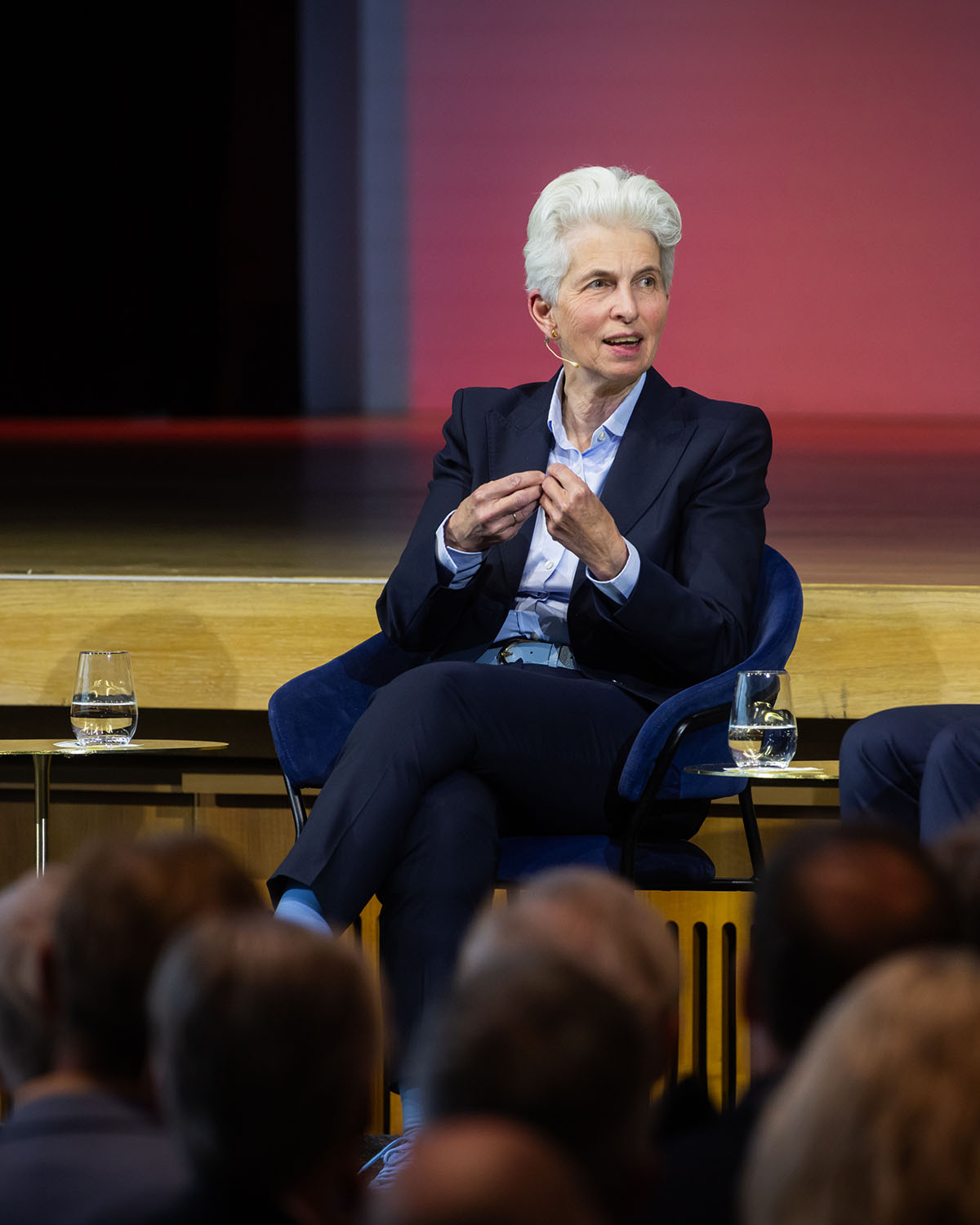
Dr. Marie-Agnes Strack-Zimmermann wurde im Juni 2024 zur Abgeordneten des Europäischen Parlaments gewählt. Dort ist sie Vorsitzende der FDP-Delegation im Europäischen Parlament und Vorsitzende des Ausschusses für Sicherheit und Verteidigung (SEDE). Von 2017 bis 2024 war sie Bundestagsabgeordnete. 2017 bis 2021 kommunal- und verteidigungspolitische Sprecherin der FDP-Bundestagsfraktion. Seit 2019 war sie im FDP-Bundesvorstand, seit 2023 wieder im FDP-Präsidium. 2021 bis 2024 Vorsitzende des Verteidigungsausschusses und Mitglied des Vorstands der FDP-Bundestagsfraktion.
Dr. Marie-Agnes Strack-Zimmermann wurde im Juni 2024 zur Abgeordneten des Europäischen Parlaments gewählt. Dort ist sie Vorsitzende der FDP-Delegation im Europäischen Parlament und Vorsitzende des Ausschusses für Sicherheit und Verteidigung (SEDE). Von 2017 bis 2024 war sie Bundestagsabgeordnete. 2017 bis 2021 kommunal- und verteidigungspolitische Sprecherin der FDP-Bundestagsfraktion. Seit 2019 war sie im FDP-Bundesvorstand, seit 2023 wieder im FDP-Präsidium. 2021 bis 2024 Vorsitzende des Verteidigungsausschusses und Mitglied des Vorstands der FDP-Bundestagsfraktion.