

The state of the multilateral trading system
May 2026
This is your guide to one of the most consequential forces shaping the global economy. In six lessons, UZH Professor of Economics and former WTO Chief Economist, Ralph Ossa takes you inside the multilateral trading system: how it was built, how it works, where it’s holding, and where it's beginning to crack. The series is based on UBS Center Public Paper #16 The Multilateral Trading System.
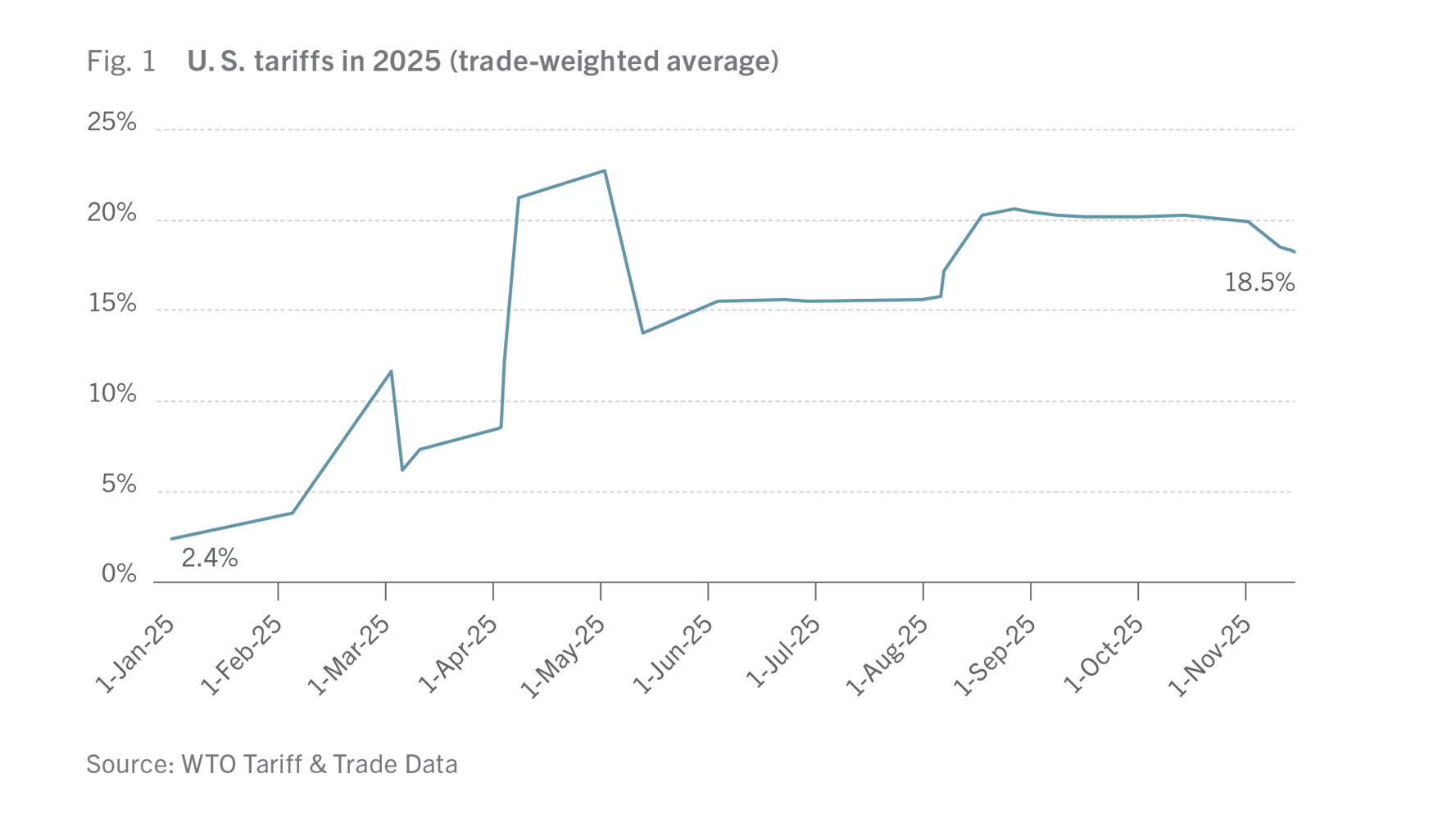
The most consequential recent development for the multilateral trading system has been a sharp shift in U. S. trade policy. Over the course of 2025, the United States unilaterally increased its tariffs from a trade-weighted average of around 2.4 percent at the beginning of the year to roughly 18.2 percent by year-end (see Figure 1). Tariff levels of this scale have not been observed in the United States since the 1930s. More importantly, they mark a return toward unilateral protection by an economy that has long played a central role in shaping and sustaining the rules based trading system, weakening confidence well beyond the immediate trade effects.
The economic consequences of this shift are already visible. The WTO estimates that the tariff increases introduced in 2025 – together with the associated rise in trade policy uncertainty – will roughly halve the growth of global merchandise trade volumes over 2025 and 2026 taken together. In its October 2025 forecast, the WTO projects merchandise trade growth of 2.4 percent in 2025 and just 0.5 percent in 2026 (see Figure 2). The stronger than- expected outcome for 2025 reflects front-loading of U. S. imports ahead of tariff increases and robust demand for AI-related products, masking a much weaker underlying trajectory.
It is important to note that U. S. tariff levels were unusually low prior to the recent increases, particularly in terms of bound most-favored-nation (MFN) tariffs. By comparison, as shown in Figure 3, bound MFN tariffs remain substantially higher in major emerging economies, averaging 48.5 percent in India, 31.3 percent in Brazil, and 10.0 percent in China. Applied tariffs are considerably lower, but still elevated by advanced-economy standards. These differences help explain why recent U. S. tariff increases, while historically large in a domestic context, do not by themselves imply a wholesale collapse of multilateral trade discipline.
While the shift in U. S. trade policy is of major significance, its systemic reach is nonetheless limited. In 2024, the United States accounted for about 14 percent of global import demand, implying that the bulk of demand originates elsewhere. Consistent with this, around 72 percent of global merchandise trade continues to be conducted under most-favored-nation (MFN) tariffs within the WTO framework, with a further 16 percent taking place under preferential trade agreements (PTA) that build on WTO rules (see Figure 4). Only the remaining share – roughly 12 percent of global merchandise trade – falls outside these disciplines and can reasonably be described as power-based rather than rules-based.
This figure is of first-order importance. It directly contradicts the increasingly common claim that the multilateral trading system, and the WTO in particular, is no longer functioning. That claim matters because expectations shape behavior. If the system is widely perceived as broken, governments have less incentive to comply with its rules, to exercise restraint in the use of unilateral measures, or to invest political capital in sustaining cooperation. Over time, such expectations risk weakening the system itself, even where its formal rules continue to structure most global trade.
At the same time, resilience should not be mistaken for robustness. One source of fragility lies in the growing reliance on bilateral “deals” that sit uneasily with core WTO principles, most notably MFN treatment. All fourteen bilateral arrangements concluded with the United States in 2025 involve tariff concessions granted specifically to the United States and not extended to other trading partners. These arrangements fall short of comprehensive free trade agreements and leave U. S. tariffs largely in place. If replicated more broadly, such practices risk eroding MFN treatment at the margin and weakening a central pillar of the multilateral trading system.
A further source of fragility arises from the nature of these bilateral arrangements themselves. Recent “deals” have often extended well beyond trade, bundling market-access concessions with commitments related to security, energy, migration, or other non-trade objectives. In such settings, bargaining power is highly uneven and reciprocity becomes harder to assess, particularly for smaller economies with limited leverage outside trade. This blurring of domains weakens the disciplining function of trade rules and increases the risk that cooperation rests on contingent political bargains rather than on predictable, rules-based commitments.
MFN itself has come under growing political pressure. The United States – and increasingly the European Union – have questioned whether non-discrimination can continue to underpin cooperation in a system marked by asymmetric tariff bindings, extensive state intervention, and limited scope for reciprocal bargaining. These concerns have contributed to a turn toward bilateral and selective arrangements. As argued in this paper, however, the resulting tensions arise not from MFN itself, but from gaps in rule coverage and in the system’s capacity to generate new bargains – a distinction that is central to how reform should be approached.
It is important to emphasize that tensions in the multilateral trading system extend well beyond recent shifts in U. S. trade policy. Debates over the compatibility of China’s state-led economic model with existing rules, concerns about the expanding regulatory reach of the European Union, and disagreements over rule-making – most visibly reflected in resistance from some members, including India, to plurilateral initiatives – have all contributed to strain. At the same time, many developing countries have grown increasingly frustrated that expectations of trade-led development have not been fulfilled, as reciprocal bargaining stalled and the development agenda remained unresolved. These sources of tension are taken up in subsequent sections of the paper.
In this series, Prof. Ralph Ossa distills his experience from academia and policy making into something rare: a clear, honest assessment of where the system actually stands today. Each lesson offers insights that stand on their own. Follow all six, and you'll come away with a complete picture – and a much sharper understanding of what holds the global economy together, and what happens when it starts to fray.
This is your guide to one of the most consequential forces shaping the global economy. In six lessons, UZH Professor of Economics and former WTO Chief Economist, Ralph Ossa takes you inside the multilateral trading system: how it was built, how it works, where it’s holding, and where it's beginning to crack. The series is based on UBS Center Public Paper #16 The Multilateral Trading System.
The most consequential recent development for the multilateral trading system has been a sharp shift in U. S. trade policy. Over the course of 2025, the United States unilaterally increased its tariffs from a trade-weighted average of around 2.4 percent at the beginning of the year to roughly 18.2 percent by year-end (see Figure 1). Tariff levels of this scale have not been observed in the United States since the 1930s. More importantly, they mark a return toward unilateral protection by an economy that has long played a central role in shaping and sustaining the rules based trading system, weakening confidence well beyond the immediate trade effects.



The multilateral trading system is widely perceived to be in crisis, undermined by geopolitical tensions, unilateral trade policies, and growing skepticism toward global cooperation. UZH Professor of Economics Ralph Ossa, who served as Chief Economist of the World Trade Organization (WTO), argues in our latest UBS Center Public Paper, that such narratives are both overstated and insufficiently precise. While the system faces real and structural pressures, it continues to govern the majority of global trade and to deliver significant economic value.
The multilateral trading system is widely perceived to be in crisis, undermined by geopolitical tensions, unilateral trade policies, and growing skepticism toward global cooperation. UZH Professor of Economics Ralph Ossa, who served as Chief Economist of the World Trade Organization (WTO), argues in our latest UBS Center Public Paper, that such narratives are both overstated and insufficiently precise. While the system faces real and structural pressures, it continues to govern the majority of global trade and to deliver significant economic value.

Ralph Ossa, who served as Chief Economist of the World Trade Organization (WTO) from January 2023 to June 2025, took up the UBS Foundation Professorship of Economics at the Department of Economics of the University of Zurich (UZH) as of July 1, 2025. Before joining the WTO, Ralph Ossa was already teaching and conducting research at UZH in the field of international economics, with a particular focus on policy-relevant questions. He was chairman of the Department of Economics from 2019 to 2022 and coeditor of the Journal of International Economics from 2016 to 2022. Prior to Zurich, he was on the faculty at the University of Chicago Booth School of Business. He holds a PhD in Economics from the London School of Economics.
Ralph Ossa, who served as Chief Economist of the World Trade Organization (WTO) from January 2023 to June 2025, took up the UBS Foundation Professorship of Economics at the Department of Economics of the University of Zurich (UZH) as of July 1, 2025. Before joining the WTO, Ralph Ossa was already teaching and conducting research at UZH in the field of international economics, with a particular focus on policy-relevant questions. He was chairman of the Department of Economics from 2019 to 2022 and coeditor of the Journal of International Economics from 2016 to 2022. Prior to Zurich, he was on the faculty at the University of Chicago Booth School of Business. He holds a PhD in Economics from the London School of Economics.