

"To say that liberalism eats at tradition is a fairy tale."
Apr 2026
Direkt zu
Direkt zu
This interview by Lukas Leuzinger and Alex Buxeda was originally published in Schweizermonat on 16.3.2026. Edited for context purposes by the UBS Center.
Cass Sunstein, you dedicate your new book “On Liberalism” to “anti-liberals everywhere,” a reference to Hayek, who dedicated his “Road to Serfdom” to “the socialists of all parties”. Do you think you can convince anti-liberals of liberalism?
I think so. In every human heart beats an enthusiasm for freedom, an appreciation that the rule of law is a good thing, a sense that pluralism has virtues because we can learn from each other and allow our friends and acquaintances to go in directions that make their lives go well. The appeal of liberalism is general, rather than particular. Some who are skeptical of freedom may take longer to be convinced; hope springs eternal and life is long.
Couldn’t the opposite also be true? Human nature seems to have two sides: one that cherishes freedom, as your dedication highlights, and another that tends toward serfdom. As Hayek wrote, “If all truths are to retain their hold on men’s minds, they must be restated in the language and concepts of successive generations.” Is your book an attempt to do that for today’s generation?
In a way. And you’re clearly right that the appeal of liberalism isn’t a simple matter. George Orwell’s “1984,” which I had long thought was basically a novelistic justification of liberalism, is much more complicated than that. Orwell suggests that every person has an attraction for order and Big Brother. I’m hopeful that my book both restates old truths in a way that maybe young people can find attractive, but also gives an account of liberalism in some ways that is particularly suited for today and that doesn’t merely say we need to go backwards and recover old wisdom.
Your tent of liberalism is very broad, including thinkers as different as Hayek and Burke.
Yes. Part of the book insists that there is a place for social and economic rights, and I believe liberals should embrace this. Many do not, and I respect them—they are still part of my team. There is much to consider regarding regulation and what it should look like. It would be shocking if Hayek or John Stuart Mill had the final word; we have learned a great deal since their time. The idea of a “big tent” for liberalism has not been fully appreciated yet. Some liberals enthusiastically support a regulatory welfare state, while others oppose it. Both are still liberals. Recognizing this diversity within a shared commitment to freedom, pluralism, and the rule of law is a major step forward—especially at a time when anti-liberal movements, both practical and theoretical, are on the rise.
Doesn’t this big tent risk diluting the term liberalism so much that, in the end, everyone is a liberal and no one really is?
Yes, but consider this: Hitler, Putin, Xi, and Orban are not liberals. Yet in North America and Europe, there are illiberal and anti-liberal movements that claim the label. Both left and right sometimes resist robust freedom of speech. Even within the “big tent” of liberalism, certain principles—like respect for religion and private property—serve as clear boundaries. If you think that a command and control economy is a great thing, that private property is something to be overcome, these are illiberal thoughts. Liberals own the celebration of property rights, and that is a pretty big tent. You can believe in property rights and think social democracy is wonderful, or you can believe in property rights and despise social democracy, but to recognize one another as family members rather than as fundamentally opposed is a step forward for humanity’s future.
Do you see the main threat to liberalism coming from external geopolitical rivals, or from within liberal societies themselves?
Russia and China’s leadership are serious threats to liberalism. In Europe and North America, we’re in the midst of something more destructive to liberal ideals than what we’ve seen in the recent past. It’s important for the West to embrace its own highest ideals. This might sound abstract, but if you think of people who are frightened, silenced, or humiliated, these are concrete things we need less of.
Can liberalism sustain itself? You write in the book that liberal societies may depend on things on which liberalism, as such, is silent.
This is the most fundamental point, and one the book did not adequately grapple with. Since Tocqueville, there has been a view that liberalism depends on things it does not itself supply—family, norms, faith, traditions—and may even endanger them. That is part of why Burke is such a complicated figure, and why it is disputed whether he counts as a liberal. It is right to say that any society depends on goods liberalism does not provide. Liberals should own that without embarrassment. Liberalism is not everything; it is a set of political commitments. What does not follow is the stronger Tocquevillian claim that liberalism eats away at the very traditions it presupposes. That turns liberalism into Voldemort, a quasi-agent in history devouring norms and faith. One could tell a story in which freedom and choice undermine tradition. To say that liberalism eats at tradition is a fairy tale. Liberalism protects freedom of speech and religion; it does not require anyone to rethink or abandon inherited commitments. If someone lives within a Catholic family tradition without having chosen it, liberalism does not punch it in the nose. It secures the right to remain in it.
Do you think post-liberals like Patrick Deneen paint a false picture of liberalism?
I would like to admire Deneen’s work more than I do. My concern is that it lacks an adequate account of what liberalism is. I am not even sure I could clearly describe liberalism as Deneen understands it. The version he criticizes, I do not like either. In that sense, I am with him. But I do not recognize it as liberalism. His sociological claims about liberalism, capitalism, and markets sometimes resemble familiar left-of-center narratives. Those are empirical claims, and they require fine-grained evidence, not a sweeping grand story. What I do admire are his moral commitments, and his concern to protect norms and traditions he regards as worthy of respect. That is a serious and honorable aim, and liberals should take it seriously.
What would be the core principle of liberalism as you define it?
Liberalism rests on a “Holy Trinity” of freedom, pluralism, and the rule of law, grounded in a commitment to self-government and “freedom from fear.” This latter—protection against public and private deprivation—is central, though often overlooked, in social contract theory. As Orwell’s image of a “boot stamping on a human face” suggests, liberalism’s primary moral aim is to prevent such horrors. Modern post-liberalism, exemplified by thinkers like Patrick Deneen, loses sight of this concern. While the relationship between liberalism and democracy is complex, and some “pro tanto” liberals prioritize personal liberty over self-rule, the core of the liberal project remains the protection of individuals from the “boot.”
You say that freedom of speech is probably the most important freedom there is. In Switzerland, a man went to prison recently for an allegedly transphobic social media post. In Germany, the police raided the house of a retiree for calling a minister an idiot. Do those cases trouble you?
Yes. I’d like to know more about them before taking a firm view. But in a system committed to freedom of expression, statements like calling a minister an idiot or claiming trans persons are “sick in the head” must be protected. My favorite line from the U.S. Supreme Court captures this perfectly: “Compulsory unification of opinion achieves only the unanimity of the graveyard.” The basic liberal idea is that people are entitled to be wrong, and that our own convictions deserve a measure of humility. Threats of violence, of course, are not protected. But expressing opinions—controversial or offensive—is strongly presumed protected in Switzerland, France, the U.K., and Canada.
You’ve become famous for the book called Nudge. Where do you think your critics clearly misunderstand the idea rather than identify with the problem?
The criticism that nudges are manipulative is a misunderstanding. Most—GPS routes, allergen labels, fuel-efficiency ratings—simply provide information. Even “default” nudges, like automatic savings plans, remain non-manipulative when there’s a clear, easy opt-out. The claim that nudges treat people as “sheep” ignores human cognition. We are not calculating machines; attention and memory are limited. Nudges that remind people to take life-saving medication—preventing perhaps 100,000 deaths annually in the U.S.—do not infantilize users. Whether elderly patients or busy CEOs, nudges acknowledge human limits and provide essential support.
Your next book is on the separation of powers. Have you been inspired by recent events?
Not really. The inspiration was more of a personal “aha” moment. While researching the separation of powers, I realized it isn’t one concept – it’s six. Each branch—legislature, executive, and judiciary—is barred from exercising the powers of the other two. Each of these six prohibitions has its own distinct justification, and their importance shifts over time. One era might rely on the executive to block an “energized” legislature from jailing citizens; another might prioritize keeping courts from legislating. I assumed this six-way breakdown was a standard idea, but I couldn’t find it anywhere. Discovering a new way to look at such a fundamental structure was what made the project so exciting.
Which of the six things do you think is most threatened at the moment?
In illiberal nations like Russia, the executive has legislative authority and judicial authority. That’s really dangerous.
What about the U.S.?
All six are doing pretty well, though the executive authority has been increasingly strong under both Democratic and Republican presidents. That’s had risks and continues to do so today.
This interview by Lukas Leuzinger and Alex Buxeda was originally published in Schweizermonat on 16.3.2026. Edited for context purposes by the UBS Center.
Cass Sunstein, you dedicate your new book “On Liberalism” to “anti-liberals everywhere,” a reference to Hayek, who dedicated his “Road to Serfdom” to “the socialists of all parties”. Do you think you can convince anti-liberals of liberalism?
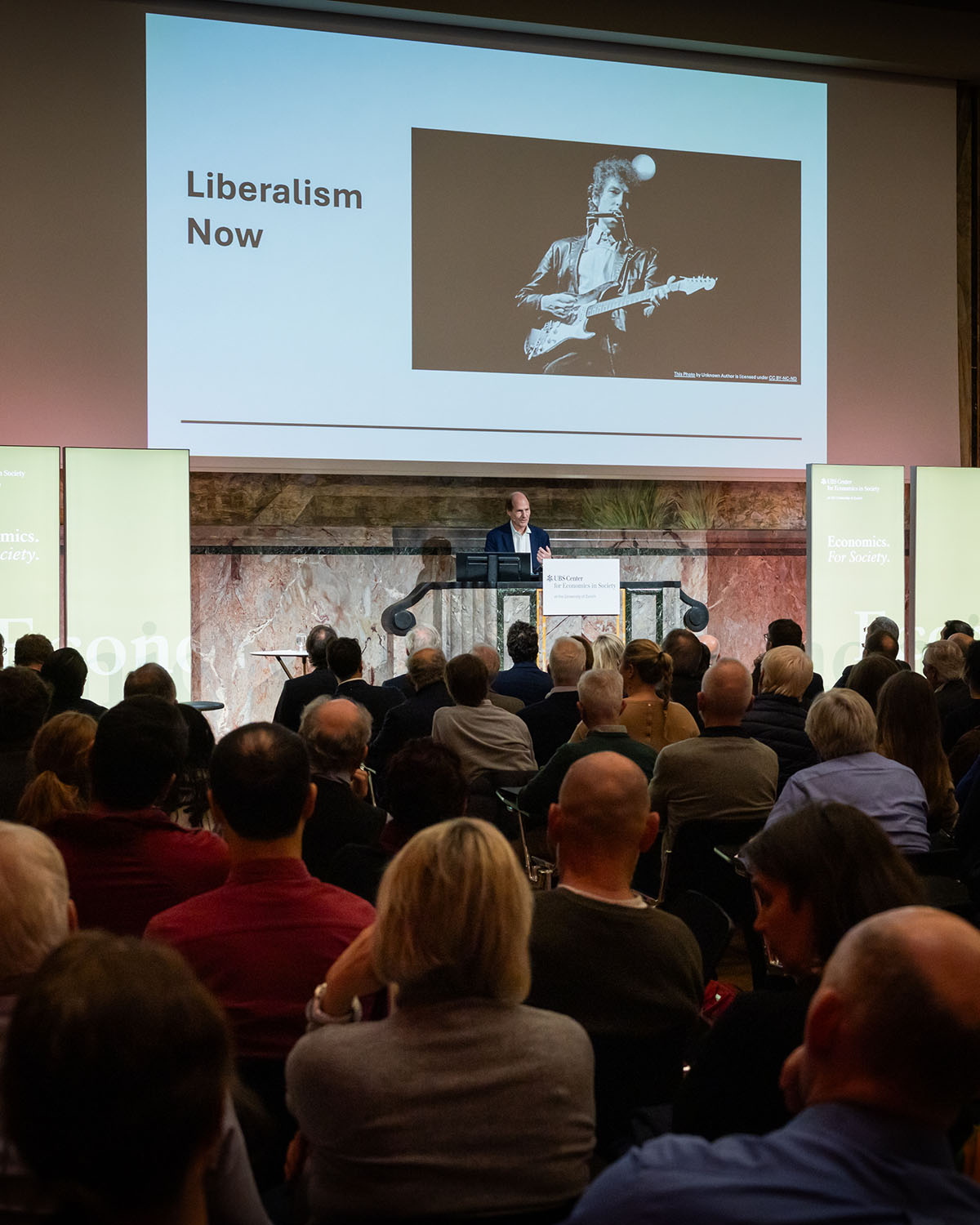
Cass R. Sunstein is the Robert Walmsley University Professor at Harvard University and founder of the Program on Behavioral Economics and Public Policy at Harvard Law School. He is also co-founder of the Initiative on Artificial Intelligence and the Law. From 2009 to 2012 he served as Administrator of the White House Office of Information and Regulatory Affairs under President Obama and later advised Presidents Obama and Biden on issues of law and public policy. One of the world’s most influential legal scholars, he has contributed fundamentally to the understanding of behavioral economics, regulation, and democratic governance. In 2018, he received the prestigious Holberg Prize for his groundbreaking work at the intersection of law and the humanities. Among his many publications are Nudge (with Nobel laureate Richard Thaler), How Change Happens, Sludge, and The Cost-Benefit Revolution. His latest book, On Liberalism, offers a timely and powerful defense of liberalism as the foundation of freedom and self-government.
Cass R. Sunstein is the Robert Walmsley University Professor at Harvard University and founder of the Program on Behavioral Economics and Public Policy at Harvard Law School. He is also co-founder of the Initiative on Artificial Intelligence and the Law. From 2009 to 2012 he served as Administrator of the White House Office of Information and Regulatory Affairs under President Obama and later advised Presidents Obama and Biden on issues of law and public policy. One of the world’s most influential legal scholars, he has contributed fundamentally to the understanding of behavioral economics, regulation, and democratic governance. In 2018, he received the prestigious Holberg Prize for his groundbreaking work at the intersection of law and the humanities. Among his many publications are Nudge (with Nobel laureate Richard Thaler), How Change Happens, Sludge, and The Cost-Benefit Revolution. His latest book, On Liberalism, offers a timely and powerful defense of liberalism as the foundation of freedom and self-government.