
Can fair decisions be calculated?
Apr 2026
This article by Barbara Simpson was originally published by UZH News on 7.4.2026 as part of UZH Magazin 1/2026. Translated by Gena Olson and edited for context purposes by the UBS Center.
During her time as an economist at the World Bank, Maya Eden’s work often involved calculating the economic impact of development programs – analysis meant to help prioritize lending decisions. Will the construction of new roads spur tangible growth? What are the economic consequences of investing in educational institutions? What about subsidizing low-income households with direct payments and welfare benefits? While infrastructure projects are judged by averages like per capita income, poverty reduction programs are about improving life for the most vulnerable, so they tend to deliver more of a “social return.”
“The question is whether you prioritize economic growth or the well-being of society’s poorest members,” says Eden. Even though her math degree and doctorate in economics had given her the tools to calculate the economic effects of specific policies, the questions she faced often took on a completely different dimension: “If you look closely, you see that economic policy issues are often ethical questions in disguise.”
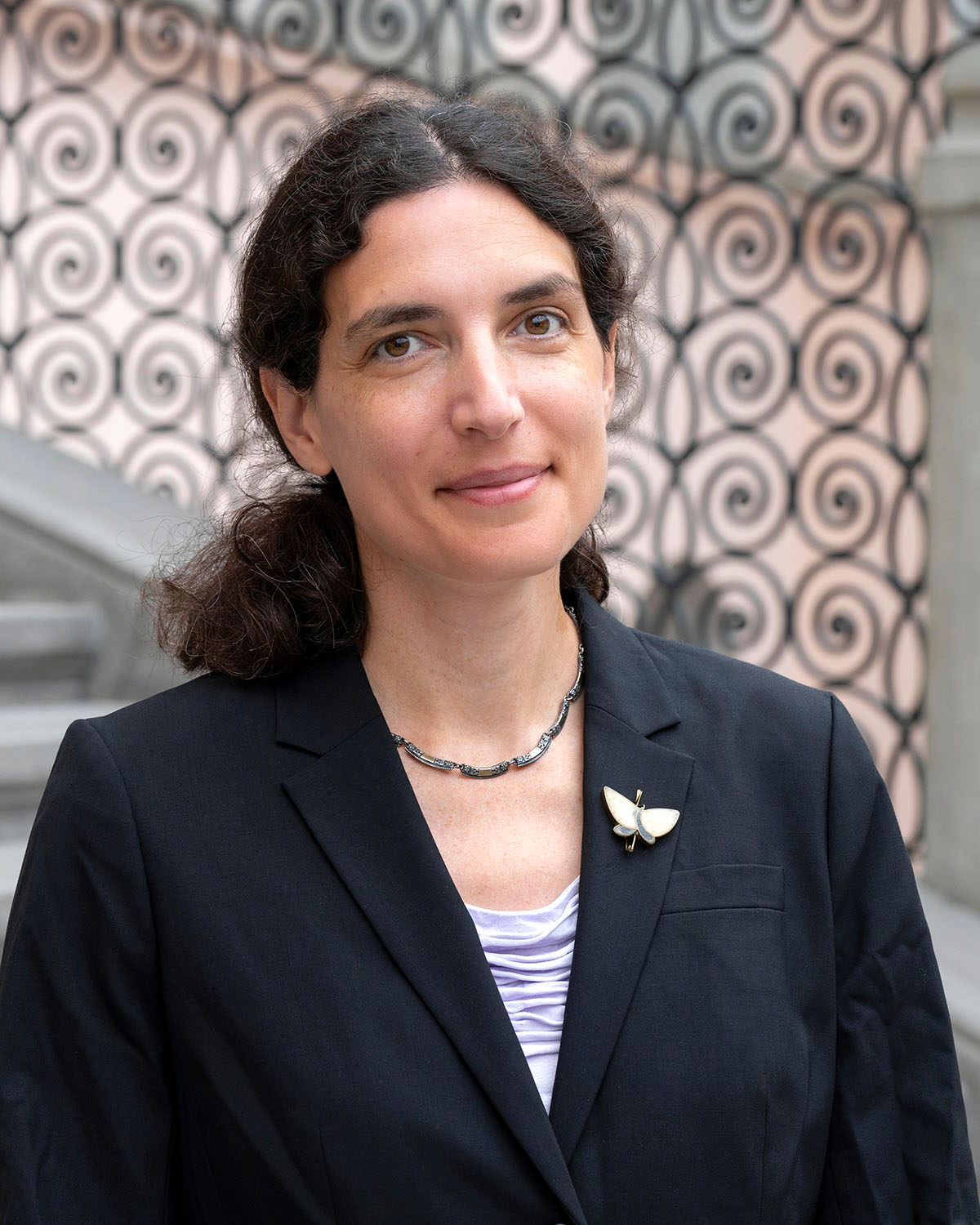
Today, Eden is a professor of economics at the University of Zurich, where she develops mathematical formulas that can measure the impact of policy measures without losing sight of ethical principles. “A lot of economists are very interested in making policy prescriptions,” she says.
However, when it comes to the normative and ethical side of economic analysis, she notes that economists often pass the buck to policymakers or ethics committees, shirking their own responsibility in the process. Should economists advocate for higher average wages or for direct support for people in poverty? It’s often gut feelings that guide the answers to moral and economic questions of this kind.
For Eden, who specialized in welfare economics, this is far too flimsy. “All too often we rely on our moral intuitions, and these can be deceiving,” she says. “We can do better by using mathematics.” She illustrates her point with a simple mathematical analogy: you might have a gut feeling about what a certain multiplication will be, but if you want the right answer, you have to do the math, not just trust your instincts.
That’s why Eden has developed a mathematical formula for making better, fairer decisions – one that produces a kind of ethical ranking of potential policy measures. Translating ethical principles into mathematical units makes them more digestible for policymakers than, say, a treatise on the same topic. Numbers have an aura of objectivity, after all.
One widely accepted ethical principle is based on the Pareto criterion. “If there is an option that makes every individual better off, or at least not worse off than before, then you should choose that option,” Eden explains. This would be a policy where no one benefits at the expense of others. However, this criterion offers little guidance in situations that produce both winners and losers.
That’s why Eden adds a second condition: equal treatment, or impartiality. “Suppose Ann has 100 francs and Bob has 50,” she explains. “That situation shouldn’t be considered better or worse than the reverse, where Bob has 100 francs and Ann has 50.”
The first condition acknowledges efficiency as a factor, while the second one considers fairness. “Taken alone, these conditions aren’t very strict,” remarks Eden. “There are a lot of options that could fulfill both.” Interestingly, this changes once a third condition is introduced: that decisions must be consistent. If A is preferable to B, and B is preferable to C, then a ranking cannot suddenly place C above A. “That means we have to consistently apply the same standard to all decision-making issues,” explains the professor. “In each instance, we could feed in criteria for making the world a better place.” In the real world, this might mean choosing the policy option that guarantees the highest per capita income or the least inequality, or some combination of the two.
“These assumptions are all very general,” says Eden. “But taken together, they allow us to make far-reaching conclusions. I want my research to explore how far we can get with shared ethical principles as our basis.” Even if the result is an “empty set”, meaning none of the tested policies satisfies all the principles, this can still be useful for guiding policymakers. It forces us to grapple with how we weigh individual principles. Which policy option comes closest to meeting the stated requirements? Which principle might we be willing to relax, and why?
Eden sees this as a path toward being able to give more honest economic policy advice. “It’s about making assumptions transparent,” she says. “That means that when doing an economic analysis, you’re forced to admit that you’re taking X and Y, but not Z, into consideration. You can’t pretend that you’re acknowledging all factors.” Even so, Eden's algorithm accounts for many eventualities that would otherwise have to be tested one by one – a tedious process. Complex and contentious issues like the minimum wage, redistributive taxation and trade policy share a common underlying pattern: some people benefit, while others are left shouldering the cost. Policymakers therefore need to justify how they intend to strike a balance between competing interests.
The next step for Eden will be testing her approach in more complex areas, such as climate change, migration policy or demographic change (see the box for more info). She acknowledges that it hasn’t yet been possible to formally translate each criterion into a mathematical unit: “When policymakers ask me whether I can factor in something like ‘preserving biodiversity,’ I have to be honest and say: ‘Not yet.’ There are lots of important values out there that current criteria still don’t adequately capture.”
Mathematical models are standard in economics, but the idea that ethical criteria can be expressed in the same way has yet to gain much traction. “However, there’s still general interest in this approach, since ethical questions tend to come up again and again,” says Eden. Many welfare economists study which economic policies can create a better world. They usually pursue the same aim: the greatest possible well-being for the greatest possible number of people – in other words, a maximization of welfare that can be pinned down in mathematical terms.
“There’s increasing recognition that this criterion is not suitable for every issue, though,” says the economist. Through her work at the intersection of economics, ethics and mathematics, Eden hopes to move beyond pure utility calculations, shine a light on hidden value assumptions and firmly integrate ethical questions into economic analysis.
This article is from UZH Magazin 1/2026 (in German)
This article by Barbara Simpson was originally published by UZH News on 7.4.2026 as part of UZH Magazin 1/2026. Translated by Gena Olson and edited for context purposes by the UBS Center.
During her time as an economist at the World Bank, Maya Eden’s work often involved calculating the economic impact of development programs – analysis meant to help prioritize lending decisions. Will the construction of new roads spur tangible growth? What are the economic consequences of investing in educational institutions? What about subsidizing low-income households with direct payments and welfare benefits? While infrastructure projects are judged by averages like per capita income, poverty reduction programs are about improving life for the most vulnerable, so they tend to deliver more of a “social return.”