

"We must not tolerate the criminalization of political opponents."
Mar 2026
This interview by Thomas Fuster and Albert Steck was originally published in NZZ on 17.1.2026 in German. Translated and edited for context purposes by the UBS Center.
Mr. Sunstein, the world is concerned about whether Donald Trump's growing claim to power is threatening democracy. You have just written a book about the principle of separation of powers. Is this still firmly established in the US?
Yes, this principle is not in danger. We can see this from the fact that there is an intense debate in the US about the extent of Trump's power. For example, the Supreme Court will soon rule on the legality of Trumps’ customs policy.
Nevertheless, one gets the impression that Trump is increasingly using the judiciary for personal gain. First, he sharply criticized the monetary policy of Federal Reserve Chairman Jerome Powell. Now his administration is even investigating him criminally.
Former Supreme Court Justice and Attorney General Robert Jackson formulated the principle that prosecutors should prosecute crimes, not people. Investigations are legitimate if there is credible evidence of wrongdoing. It becomes problematic when a person is targeted first and then specific misconduct is sought.
The government claims that it is indeed looking at specific wrongdoing and points to Powell's alleged mismanagement of the Federal Reserve's renovation work.
When a government prosecutes someone for political reasons or personal animosity, things are going wrong. We cannot tolerate the criminalization of political opponents in our constitutional state. I served in the administration of President Obama, and he always adhered to this principle.
What did Obama do specifically?
He refrained from prosecuting former members of the Bush administration. Admittedly, there were serious allegations of illegal torture after the terrorist attacks of September 11, 2001. Many therefore called for the prosecution of former government officials. But Obama resisted this. That was courageous and admirable. Democracies are endangered when political opponents are criminalized. I hope that this will not happen in the future.
Customs policy remains a legal point of contention in the US. Trump justifies it on the grounds of national security. Can he do that?
The Constitution clearly separates the legislative power of Congress from the executive power of the president. As commander-in-chief of the armed forces, the president can act immediately in the event of a sudden or imminent attack. However, he cannot impose tariffs simply because he considers it important for reasons of national security. He needs a legal source that gives him the authority to do so. Whether this is the case with tariffs is a legally complex question.
Nevertheless, Trump continues to argue publicly that tariffs are a matter of national security.
This demonstrates the stability of the separation of powers: Trump may argue this way, but this will not suffice before the Supreme Court. That is why the president's lawyers refer to specific legal authorizations. Their arguments may not always be legally convincing, but they are not absurd, and they do not constitute an attack on the constitutional order.
The system works.
Yes. The president does not question the ultimate authority of the judiciary. The Department of Justice recognizes that the courts decide what is legally correct. Although there are major challenges, the independence of the judiciary is respected. This is also evident in the Supreme Court's recent ruling on the National Guard, which rejects the president's argument. The government has accepted the decision and declared that it will abide by the law.
And how do you assess the American intervention in Venezuela from a legal perspective?
I have not examined the case in detail. Many people consider the action in Venezuela to be compatible with US law, but suspect a conflict with international law.
Not only in the US, but elsewhere too, it is clear that many sympathize with the idea of strong leaders who flout the law in the supposed interests of their country.
The appeal of strong personalities is deeply rooted in the human psyche, especially in times of uncertainty or threat. Pop culture examples such as the Star Wars films or George Orwell's novel 1984 show that people are willing to follow powerful figures who seem to do everything right. Orwell describes Big Brother in a rather ambivalent way: he is not a satanic figure, but exerts an almost erotic attraction.
Why do people love Big Brother?
We could all die at any moment. And if there is someone who protects us, that is very powerful.
What does that mean for the political system?
The appeal of a strong leader is understandable and often a good thing. When a country is in trouble and there is someone who can save it, that is a good thing. Think of Franklin D. Roosevelt in the 1930s. He is one of my heroes; he pulled the US out of the Great Depression and probably helped the world in the process. Winston Churchill was also a very strong leader. There are strong leaders who respect the separation of powers.
Here in Switzerland, we prefer weak people in government. That fits better with our consensus-based democracy.
Switzerland has a very good track record. The way things have developed, the country is a beacon for the world.
From a historical perspective, are strong leaders more of a benefit or a burden?
Strong leaders carry higher risks, but they can be decisive in crises. Strength is multifaceted: on the one hand, there are tyrants, and on the other, there are responsible, decisive leaders. I mention Obama again as an example. He acted decisively during the financial crisis to save the economy, but he always abided by the law. Strength is crucial in crises. Strong leadership can stimulate economic growth.
In the US, however, personal strength also provokes resistance. Citizens take to the streets against Trump and chant “No kings.”
This tradition is deeply rooted in our country. It dates back to April 1775 in Massachusetts, when American farmers repelled British troops. This gave rise to the cry of “No kings”: a distrust of absolute power. Although many Americans support strong personalities like Trump, they strictly reject the idea of a modern king.
Power politics dominates the new world order. This favors leaders such as Xi Jinping in China and Vladimir Putin in Russia. Are we heading toward an era of autocrats?
Not necessarily. Strong leaders are not necessarily autocratic. There are also leaders with clear visions in democracies. But the danger remains that political power is often abused to suppress opponents and throw them in prison.
Many Western countries are suffering from a reform blockade. Is it easier to implement changes quickly in an autocratic system like China's?
No. Under President Obama, I headed the Office of Information and Regulatory Affairs. We issued around 2,000 regulations within four years. My experience was that decisions can also be made quickly in a democracy. Nevertheless, there is an urgent need to reduce bureaucratic inertia, especially in Europe. Many countries have recognized that they need to take action. They could learn from Singapore, for example: not long ago, I was involved in a reform project there. When I asked people when it would be implemented, the answer was: in a few weeks.
But Singapore also has some authoritarian traits. Is the model of liberalism coming under increasing pressure?
Yes, that is to be feared. The pursuit of the rule of law, freedom, and pluralism has had a decisive influence on Europe and the US over the last few decades. I would describe this as a glorious period in human history. But liberalism is coming under pressure from both the left and the right. When I started working on my book about liberalism, I was primarily focused on the attacks from the political left.
Why?
The left operated with the combative term “neoliberalism” and used it to discredit liberalism as a whole. Unemployment, social inequality, racism, and sexism: all these issues were immediately—and falsely—portrayed as systemic failures of liberalism.
But now you are more concerned about attacks from the right?
The anti-liberal right is gaining ground worldwide. It accuses liberalism of being too weak to solve today's problems. Other accusations include that liberalism pays too little attention to family or religion. These attacks are often not about complex issues such as immigration, which can be viewed differently from a liberal perspective. Rather, they question fundamental principles such as freedom of speech and the rule of law. I consider this to be very dangerous.
What reasons do you see for the weakness of liberalism? Does the model fail to provide the right answers to today's problems?
I think that liberalism will continue to hold its own in the future. Its ideals have been met with hostility before. Some people longed for a strong leader and viewed freedom and pluralism as obstacles. But ultimately, liberal principles have generally prevailed time and again.
As a scholar, you are enormously productive and have written five books in the last year alone, on topics such as the separation of powers, liberalism, and manipulation in the age of social networks. How do you manage such an enormous output?
In general, I prefer writing rather than watching television in my free time. Many of these books were long-term projects, some of which began twenty years ago. Only the book on the separation of powers took me just nine months to complete – I was carried away by my enthusiasm for the subject.
Your spectrum is very broad: in addition to your most famous book on nudging, you have also written a successful analysis of the Star Wars saga. Yet you are actually a law professor.
Studying law teaches you to work hard, which is helpful when writing books. Nudging is about using behavioral economics methods to improve people's decisions. What also drives me, of course, are my personal convictions. These include my commitment to animal welfare. I stand by these convictions, even though they have earned me some opponents and even death threats. My concern for animal welfare almost cost me my job under President Obama.
This interview by Thomas Fuster and Albert Steck was originally published in NZZ on 17.1.2026 in German. Translated and edited for context purposes by the UBS Center.
Mr. Sunstein, the world is concerned about whether Donald Trump's growing claim to power is threatening democracy. You have just written a book about the principle of separation of powers. Is this still firmly established in the US?
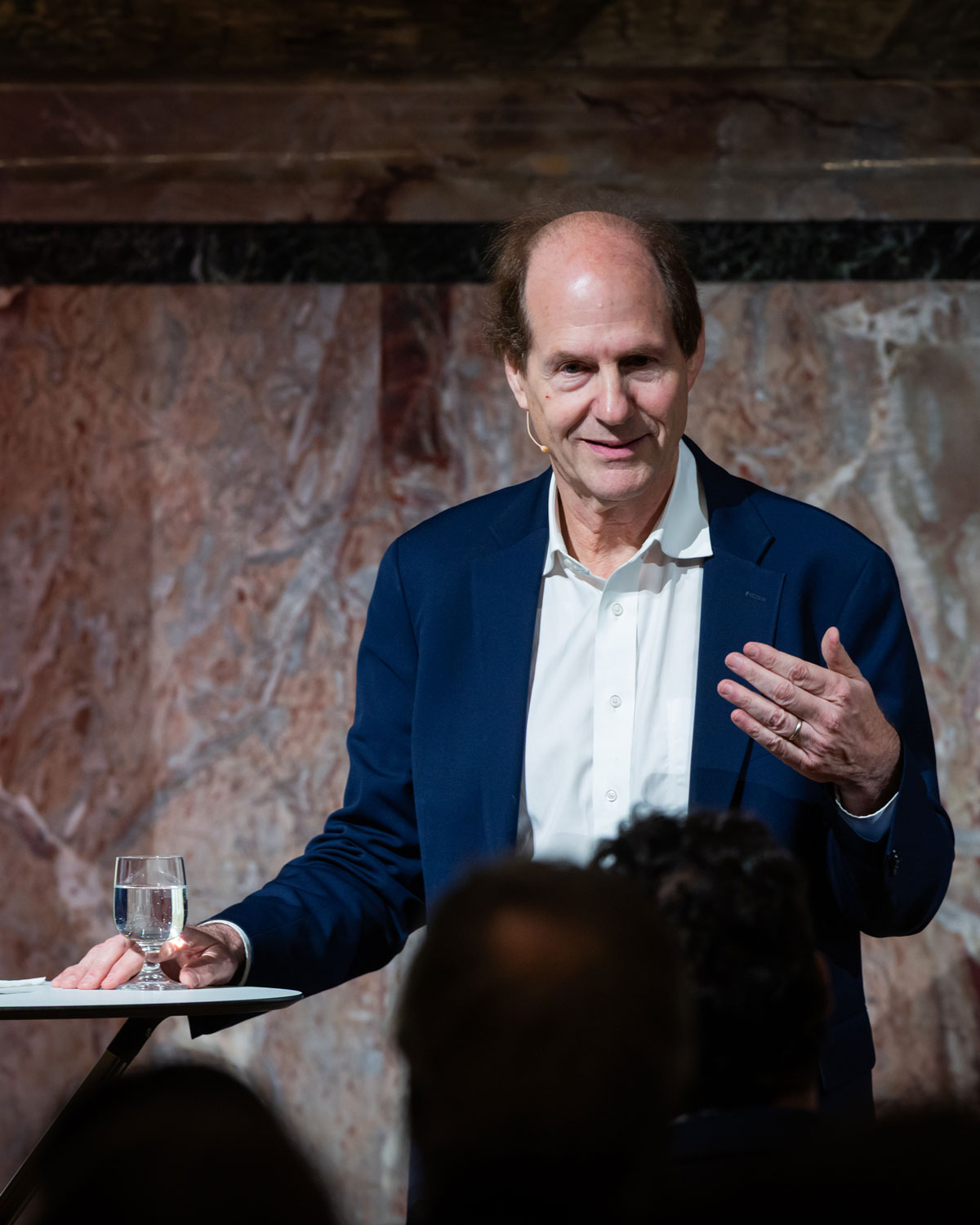
Cass R. Sunstein is the Robert Walmsley University Professor at Harvard University and founder of the Program on Behavioral Economics and Public Policy at Harvard Law School. He is also co-founder of the Initiative on Artificial Intelligence and the Law. From 2009 to 2012 he served as Administrator of the White House Office of Information and Regulatory Affairs under President Obama and later advised Presidents Obama and Biden on issues of law and public policy. One of the world’s most influential legal scholars, he has contributed fundamentally to the understanding of behavioral economics, regulation, and democratic governance. In 2018, he received the prestigious Holberg Prize for his groundbreaking work at the intersection of law and the humanities. Among his many publications are Nudge (with Nobel laureate Richard Thaler), How Change Happens, Sludge, and The Cost-Benefit Revolution. His latest book, On Liberalism, offers a timely and powerful defense of liberalism as the foundation of freedom and self-government.
Cass R. Sunstein is the Robert Walmsley University Professor at Harvard University and founder of the Program on Behavioral Economics and Public Policy at Harvard Law School. He is also co-founder of the Initiative on Artificial Intelligence and the Law. From 2009 to 2012 he served as Administrator of the White House Office of Information and Regulatory Affairs under President Obama and later advised Presidents Obama and Biden on issues of law and public policy. One of the world’s most influential legal scholars, he has contributed fundamentally to the understanding of behavioral economics, regulation, and democratic governance. In 2018, he received the prestigious Holberg Prize for his groundbreaking work at the intersection of law and the humanities. Among his many publications are Nudge (with Nobel laureate Richard Thaler), How Change Happens, Sludge, and The Cost-Benefit Revolution. His latest book, On Liberalism, offers a timely and powerful defense of liberalism as the foundation of freedom and self-government.