

Why economic growth is not automatic – and requires destruction
Jan 2026
This article by NZZ Live was originally published in NZZ on 18.11.2025 in German. Translated and edited for context purposes by the UBS Center.
In October, it was announced that this year's Nobel Prize in Economics would go to Joel Mokyr, Philippe Aghion, and Peter Howitt—three economists whose research on sustainable growth and creative destruction has fundamentally changed our understanding of growth. They show that progress is not guaranteed, but requires openness, knowledge transfer, and conditions supportive of innovation. The discussion occurred on Tuesday, November 11, 2025, at an event organized by NZZ Live in Zurich, which took the opportunity to ask some key questions anew: How can growth be shaped in times of technological upheaval, geopolitical uncertainty, and ecological constraints? And what do the laureates' findings mean for politics, the economy, and society?
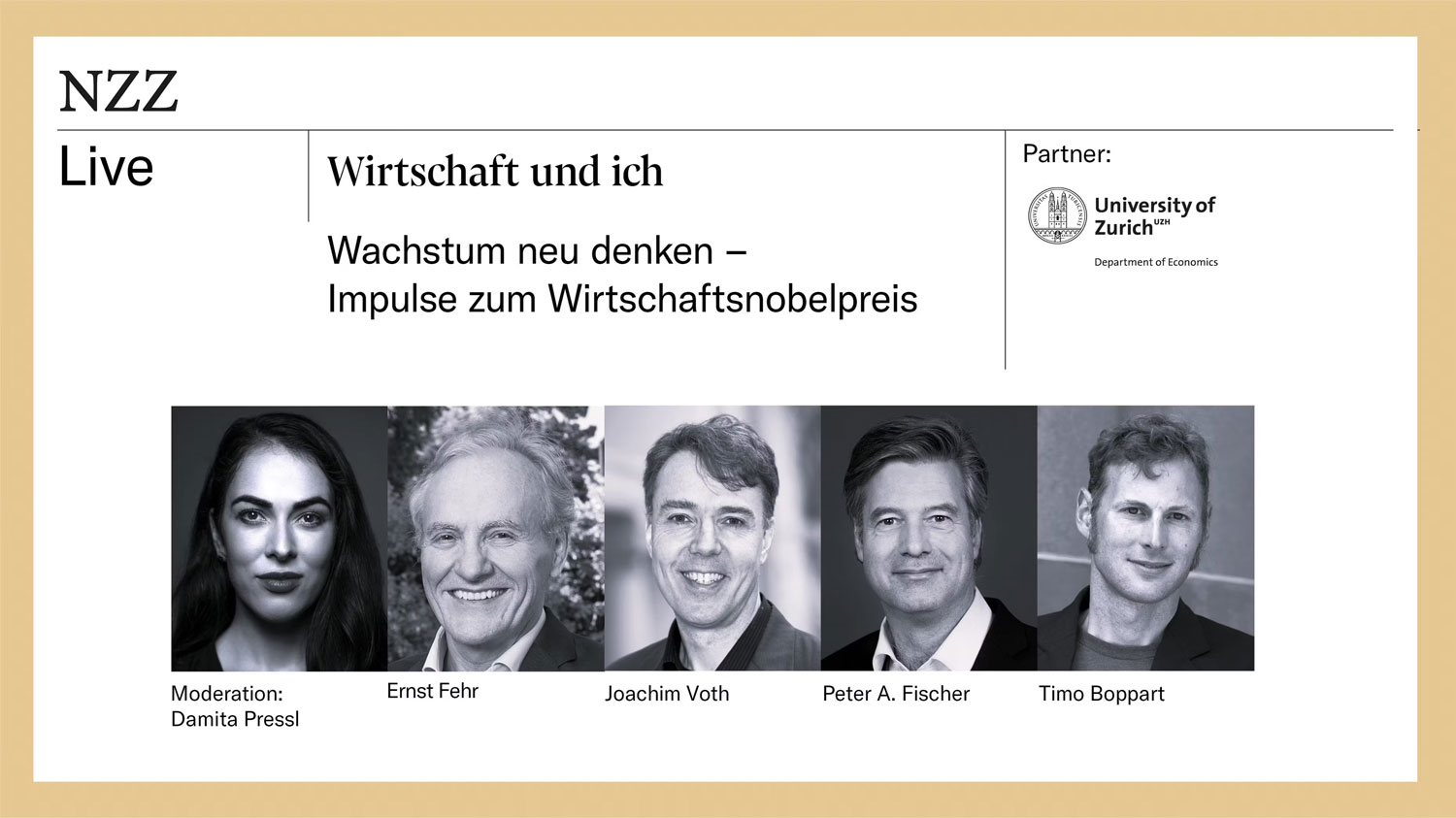
Moderated by journalist and host Damita Pressl, former video editor at NZZ, four economists discussed the topic “Rethinking growth – insights from the Nobel Prize in Economics”: Ernst Fehr, Director of the UBS Center for Economics in Society at the University of Zurich and Chairman of the Board of Directors of FehrAdvice & Partners, Timo Boppart and Joachim Voth, both Professors of Economics at the University of Zurich, and Peter A. Fischer, Chief Economist at NZZ and Editorial Director of “NZZ Pro.” The discussion format in the “Economics and Me” series was supported by content partner University of Zurich, Department of Economics (see info box below).
At the beginning of his keynote speech, Timo Boppart reminded the audience what this year's award was for: “It's about explaining innovation-driven, sustained economic growth.” He used a graph to show how real gross domestic product (GDP) per capita in the US has developed over the centuries. Even small but steady growth rates have an enormous impact: “Growth of 1.5 percent per year doubles income over a working life.”
Timo Boppart went on to explain that Joel Mokyr's contribution primarily highlights the historical dimension. Sustainable growth depends on the interplay of technical knowledge, mechanical expertise, social openness, and institutional stability. Without the willingness to question existing knowledge and recombine it, progress will not happen. “This is what we refer to as creative destruction,” he said.
Timo Boppart also added a theoretical perspective, describing the work of Philippe Aghion and Peter Howitt as milestones in modern growth theory. “They show how innovations come from below—through entrepreneurs who displace existing technologies and thereby force progress,” he explained.
Finally, Timo Boppart spoke of a “climb up the quality ladder,” where companies try to outdo each other. Monopoly winners are only temporary, he said, because new competitors quickly replace them. He emphasized that this way of thinking moves away from static models toward a dynamic view in which change is not a disruption but a driving force.
Peter A. Fischer examined the findings from a Swiss perspective. “We are strong in terms of breadth in education, but we are losing momentum and performance orientation at the top,” he said. Although the Swiss innovation system is solid, real growth spurts often occur elsewhere. “Many startups that originate here grow big in the US – because there is more venture capital available there, less regulation, and a more growth-oriented mindset.” Switzerland lacks openness to change. However, Switzerland's strengths include a flexible labor market that allows it to respond to structural change and a strong franc, which constantly forces companies to adapt to the market.
Peter A. Fischer then praised Switzerland's stability but warned against complacency. An aging society tends toward inertia, while technological leaps require adaptability. Innovation only occurs when people are prepared to let go of the old and embrace the new. “You can't live on substance alone.”
Ernst Fehr expressed the opinion that industrial policy does not necessarily have to be counterproductive. “Good industrial policy promotes competition, while poor policy protects old structures,” he said. As a positive example, he cited the US research agency Defense Advanced Research Projects Agency (DARPA), which finances ambitious projects in a competition-driven manner without artificially keeping companies alive. “Europe needs this too.”
Ernst Fehr also emphasized that successful economic policy is not based on subsidies or isolationism but is characterized by the targeted promotion of innovation. According to Peter A. Fischer, it is not always easy to distinguish between those industrial policies that promote growth and those that preserve structures. “The goal must always be to advance technology and promote research rather than subsidize individual companies.”
A central topic of discussion was the question of how artificial intelligence, as a technological advance, will affect future growth. “We don't yet know how high the productivity gains generated by artificial intelligence will be,” admitted Timo Boppart. However, it is certain that there will be losers and that the world of work will change significantly. Not only routine tasks will be affected, but increasingly also demanding professions. “This is a prime example of creative destruction,” he explained. That is why it is important to enable new technologies while at the same time cushioning the transition for those affected.
Joachim Voth mentioned historical parallels: technological revolutions and advances have always existed, but the difference today lies in the speed at which they occur. Even in 18th-century Europe, competition, cultural diversity, and mobility accelerated technological progress. “Societies that embrace new ideas and enable people to advance are more innovative in the long term.” Today, Europe is too monocultural and tends to level things out.
Ernst Fehr called for Switzerland to invest more heavily in scientific excellence. “We need universities that are not just good, but world-class – and that attract the best minds.” This is also a form of openness. However, this requires financial resources, some of which come from the state, but also from private donations. Due to the situation in the US, there is currently an enormous opportunity to attract good scientists.
When asked how well economic findings are received in politics, Timo Boppart said: "To be honest, not well enough. In Sweden, it is standard practice for the Ministry of Finance to invite researchers from universities to present their findings. That hardly ever happens here.“ He identified several reasons for this: politicians often seek quick answers, the media prefer pointed opinions from self-proclaimed experts, and many economists themselves are too reticent. ”There is the concept of a professor's third mission in Sweden: after teaching and research comes the mission to give something back to society."
Peter A. Fischer partially disagreed: “It's true that many economists are reluctant to take a stand. But there are also positive exceptions.” Ultimately, it's about ensuring that economic insights find their way into practice – in business and in politics.“ Joachim Voth added that in the US, for example, the exchange between science and politics is much more firmly anchored in institutional structures. ”There, it's normal for professors to move to a ministry for two years and then return to the university. We don't have this revolving door."
Finally, Timo Boppart, member of the Swedish Academy's Committee for the Nobel Memorial Prize in Economic Sciences, gave a brief glimpse behind the scenes. “The decision is made in the morning and announced a few hours later,” he explained. The nominations are not public, and many names circulate among experts. “I think many people know that they are on an extended list.” It is not always possible to reach the winners immediately. This year, however, Philippe Aghion answered the phone right away.
This article by NZZ Live was originally published in NZZ on 18.11.2025 in German. Translated and edited for context purposes by the UBS Center.
In October, it was announced that this year's Nobel Prize in Economics would go to Joel Mokyr, Philippe Aghion, and Peter Howitt—three economists whose research on sustainable growth and creative destruction has fundamentally changed our understanding of growth. They show that progress is not guaranteed, but requires openness, knowledge transfer, and conditions supportive of innovation. The discussion occurred on Tuesday, November 11, 2025, at an event organized by NZZ Live in Zurich, which took the opportunity to ask some key questions anew: How can growth be shaped in times of technological upheaval, geopolitical uncertainty, and ecological constraints? And what do the laureates' findings mean for politics, the economy, and society?

With the UZH Department of Economics as a content partner, the NZZ Live event series Wirtschaft und ich (in German) gets to the heart of topics and studies from the field of economics: How does economics affect me? In 90 minutes, experts from academia and research at the UZH Department of Economics share their knowledge. They show how economic insights are important for our daily lives and how they influence the decisions we make every day.
With the UZH Department of Economics as a content partner, the NZZ Live event series Wirtschaft und ich (in German) gets to the heart of topics and studies from the field of economics: How does economics affect me? In 90 minutes, experts from academia and research at the UZH Department of Economics share their knowledge. They show how economic insights are important for our daily lives and how they influence the decisions we make every day.
Timo Boppart joined the UZH Department of Economics as Professor of Macroeconomics and Political Economy in 2024. Boppart’s research work focuses on the field of economic growth, firm dynamics, labor supply and development. Completing his doctorate in 2012 at the University of Zurich, he then moved to the Institute for International Economic Studies at Stockholm University, where he was an associate professor from 2019 - 2024. In 2020, he was also appointed full professor at the Swiss Institute for International Economics and Applied Economic Research at the University of St. Gallen. He has been a member of the prize committee for the Alfred Nobel Memorial Prize in Economic Sciences since 2023.
Ernst Fehr received his doctorate from the University of Vienna in 1986. His work has shown how social motives shape the cooperation, negotiations and coordination among actors and how this affects the functioning of incentives, markets and organisations. His work identifies important conditions under which cooperation flourishes and breaks down. The work on the psychological foundations of incentives informs us about the merits and the limits of financial incentives for the compensation of employees. In other work he has shown the importance of corporate culture for the performance of firms. In more recent work he shows how social motives affect how people vote on issues related to the redistribution of incomes and how differences in people’s intrinsic patience is related to wealth inequality. His work has found large resonance inside and outside academia with more than 100’000 Google Scholar citations and his work has been mentioned many times in international and national newspapers.
Joachim Voth received his PhD from Oxford in 1996. He works on financial crises, long-run growth, as well as on the origins of political extremism. He has examined public debt dynamics and bank lending to the first serial defaulter in history, analysed risk-taking behaviour by lenders as a result of personal shocks, and the investor performance during speculative bubbles. Joachim has also examined the deep historical roots of anti-Semitism, showing that the same cities where pogroms occurred in the Middle Age also persecuted Jews more in the 1930s; he has analyzed the extent to which schooling can create radical racial stereotypes over the long run, and how dense social networks (“social capital”) facilitated the spread of the Nazi party. In his work on long-run growth, he has investigated the effects of fertility restriction, the role of warfare, and the importance of state capacity. Joachim has published more than 80 academic articles and 3 academic books, 5 trade books and more than 50 newspaper columns, op-eds and book reviews. His research has been highlighted in The Economist, the Financial Times, the Wall Street Journal, the Guardian, El Pais, Vanguardia, La Repubblica, the Frankfurter Allgemeine, NZZ, der Standard, der Spiegel, CNN, RTN, Swiss and German TV and radio.
Timo Boppart joined the UZH Department of Economics as Professor of Macroeconomics and Political Economy in 2024. Boppart’s research work focuses on the field of economic growth, firm dynamics, labor supply and development. Completing his doctorate in 2012 at the University of Zurich, he then moved to the Institute for International Economic Studies at Stockholm University, where he was an associate professor from 2019 - 2024. In 2020, he was also appointed full professor at the Swiss Institute for International Economics and Applied Economic Research at the University of St. Gallen. He has been a member of the prize committee for the Alfred Nobel Memorial Prize in Economic Sciences since 2023.
Ernst Fehr received his doctorate from the University of Vienna in 1986. His work has shown how social motives shape the cooperation, negotiations and coordination among actors and how this affects the functioning of incentives, markets and organisations. His work identifies important conditions under which cooperation flourishes and breaks down. The work on the psychological foundations of incentives informs us about the merits and the limits of financial incentives for the compensation of employees. In other work he has shown the importance of corporate culture for the performance of firms. In more recent work he shows how social motives affect how people vote on issues related to the redistribution of incomes and how differences in people’s intrinsic patience is related to wealth inequality. His work has found large resonance inside and outside academia with more than 100’000 Google Scholar citations and his work has been mentioned many times in international and national newspapers.
Joachim Voth received his PhD from Oxford in 1996. He works on financial crises, long-run growth, as well as on the origins of political extremism. He has examined public debt dynamics and bank lending to the first serial defaulter in history, analysed risk-taking behaviour by lenders as a result of personal shocks, and the investor performance during speculative bubbles. Joachim has also examined the deep historical roots of anti-Semitism, showing that the same cities where pogroms occurred in the Middle Age also persecuted Jews more in the 1930s; he has analyzed the extent to which schooling can create radical racial stereotypes over the long run, and how dense social networks (“social capital”) facilitated the spread of the Nazi party. In his work on long-run growth, he has investigated the effects of fertility restriction, the role of warfare, and the importance of state capacity. Joachim has published more than 80 academic articles and 3 academic books, 5 trade books and more than 50 newspaper columns, op-eds and book reviews. His research has been highlighted in The Economist, the Financial Times, the Wall Street Journal, the Guardian, El Pais, Vanguardia, La Repubblica, the Frankfurter Allgemeine, NZZ, der Standard, der Spiegel, CNN, RTN, Swiss and German TV and radio.