
"The EU should have joined forces with Switzerland to stand up to Donald Trump on tariffs"
Jan 2026
This interview by Simon Schmid was originally published in Tages-Anzeiger on 10.11.2025 in German. Translated and edited for context purposes by the UBS Center.
What does Switzerland represent to you?
I see Switzerland as a country with a diverse population and a strong sense of social cohesion. Many immigrants are exceptionally well integrated into the labor market. The political system is stable, the infrastructure works efficiently, and many companies are global leaders in innovation.
Is Switzerland also something of a free rider?
Geopolitical tensions are high. Given recent developments, closer cooperation with Europe on defense would be desirable. The fact that Germany could not deliver Swiss-made ammunition to Ukraine because of Switzerland’s neutrality has caused considerable incomprehension in Germany.
Does that mean higher military spending is needed?
Most European countries will have to spend more on their militaries in the future. Switzerland should follow suit. It has no interest in seeing Russia expand its influence. Defense cooperation would also benefit the economy. Europe lags behind technologically in several military areas, and Swiss companies could help close that gap, while benefiting themselves.
Switzerland hesitates to move closer to the EU, fearing a loss of sovereignty.
Many people in Germany don’t like being told what to do by Brussels either. But if you want a highly productive, globally connected economy, it’s an illusion to think you can make all the rules yourself. Even within Germany, Bavaria, for example, must accept that some regulations come from Berlin.
In the case of the EU, the rules come from Brussels. How much bureaucracy does that impose on member states?
Less than one might think. It’s often up to the member states how complicated they make the implementation of EU rules. Sometimes, however, Brussels overshoots the mark with its regulations.
Can you give an example?
The new Supply Chain Act requires companies to establish extensive monitoring systems to ensure compliance with human rights and environmental standards across all their suppliers. Such monitoring is complex and costly but has limited practical impact. I don’t think the law will remain in its current form.
What about the ban on combustion-engine cars?
Two years ago, the EU decided that only zero-emission cars would be approved from 2035 onward. In Germany, this has triggered endless debate: Chancellor Merz wants to overturn the phaseout, fearing it will hurt German carmakers. But that’s short-sighted. The manufacturers have already invested heavily in electric mobility. I hope the EU stands firm.
Why?
Because the future lies in electric vehicles. China is already overtaking Europe technologically in this field. Keeping up will require major efforts and a clear focus. Otherwise, we risk what happened in France when subsidies for electric cars were cut back: consumers bought not only fewer EVs but also fewer combustion cars, because they were unsure where things were headed. That’s certainly not in the German auto industry’s interest.
Germany’s economy has been stagnating for three years. When will growth return?
This year, growth will be modest – according to the government’s latest forecast, just 0.2 percent. Next year, it’s expected to rise to over 1 percent. Of course, these aren’t spectacular numbers. But it would be the first step forward in a long time.
The government plans to take on billions in new debt. Will the money be well spent?
If the money primarily goes toward investment, for example, in drone technology, it can generate additional growth of 0.5 to 1 percent per year. However, the government also intends to use some of the new fiscal leeway indirectly for consumption spending, such as additional pension benefits for mothers. That will reduce the overall growth effect, which is not ideal.
Chancellor Merz accuses Germans of complacency. Is he right?
On an individual level, no. Many young people today work harder than my generation did at their age, if only because education and housing are more expensive than they used to be. But as a country, Germany needs to step out of its comfort zone. China now produces not only cheaper but often better products. Instead of asking, “How can we save our existing industries?” we should be thinking about which new technologies will matter in the future.
Which ones, for instance?
Autonomous driving would be a huge opportunity. Yet unlike in San Francisco, there are no robotaxis operating here. Nor do I sense much determination to change that. You often hear statements like, “Drivers here don’t want to give up control.”
Given all the construction sites and adverse weather conditions in Switzerland, I’d also hesitate to get into a self-driving car.
That’s only a matter of time. Young people will embrace it quickly, and older people will appreciate being able to stay mobile longer. What matters now is to adapt regulations across Europe so that a car can drive autonomously not only on a test track in Stuttgart but also in Frankfurt, Paris, or Zurich.
Is Europe talking too little about Europe?
Definitely. Take trade policy, for example. When U.S. President Trump launched his tariff dispute in April, the EU should have joined forces with Switzerland, Norway, and the United Kingdom to stand up to him. That could have produced a more balanced deal instead of a tariff dictate imposed by the U.S.
Is Europe engaged in a global struggle between systems?
In a way, yes. It’s no longer a given that democracy is seen as the preferred form of government. The rules-based order has been replaced by a logic of power. This shift is most visible in the transformation of the U.S. under Trump.
How dangerous is what’s happening there?
We’re seeing a president who is instrumentalizing the political system and the judiciary to exert massive influence on the business world. Entrepreneurs and managers are capitulating out of fear of losing contracts or facing political retaliation. The country is moving from a liberal democracy toward autocracy.
How can societies mitigate authoritarian and populist movements?
That’s one of the most important questions of our time. People become susceptible to such ideologies when they feel the state no longer functions – when no bus runs, no doctor is available, and no grocery store remains. That’s what must be countered.
How?
By giving people a sense of perspective, especially in regions hardest hit by structural change. You can’t just tell them, “Move to where the jobs are.” That ignores people’s realities: they may not find affordable housing elsewhere, and they often have local roots or family obligations, such as caring for elderly parents.
Can local economic growth defeat populism?
Certainly not on its own. Populist parties also address issues of culture and identity. The political center must offer answers to those as well. That’s why it’s so important that democratic centrist parties stop squabbling over trivialities and start delivering results. People will only turn away from populists when they see that what’s being offered actually works.
This interview by Simon Schmid was originally published in Tages-Anzeiger on 10.11.2025 in German. Translated and edited for context purposes by the UBS Center.
What does Switzerland represent to you?
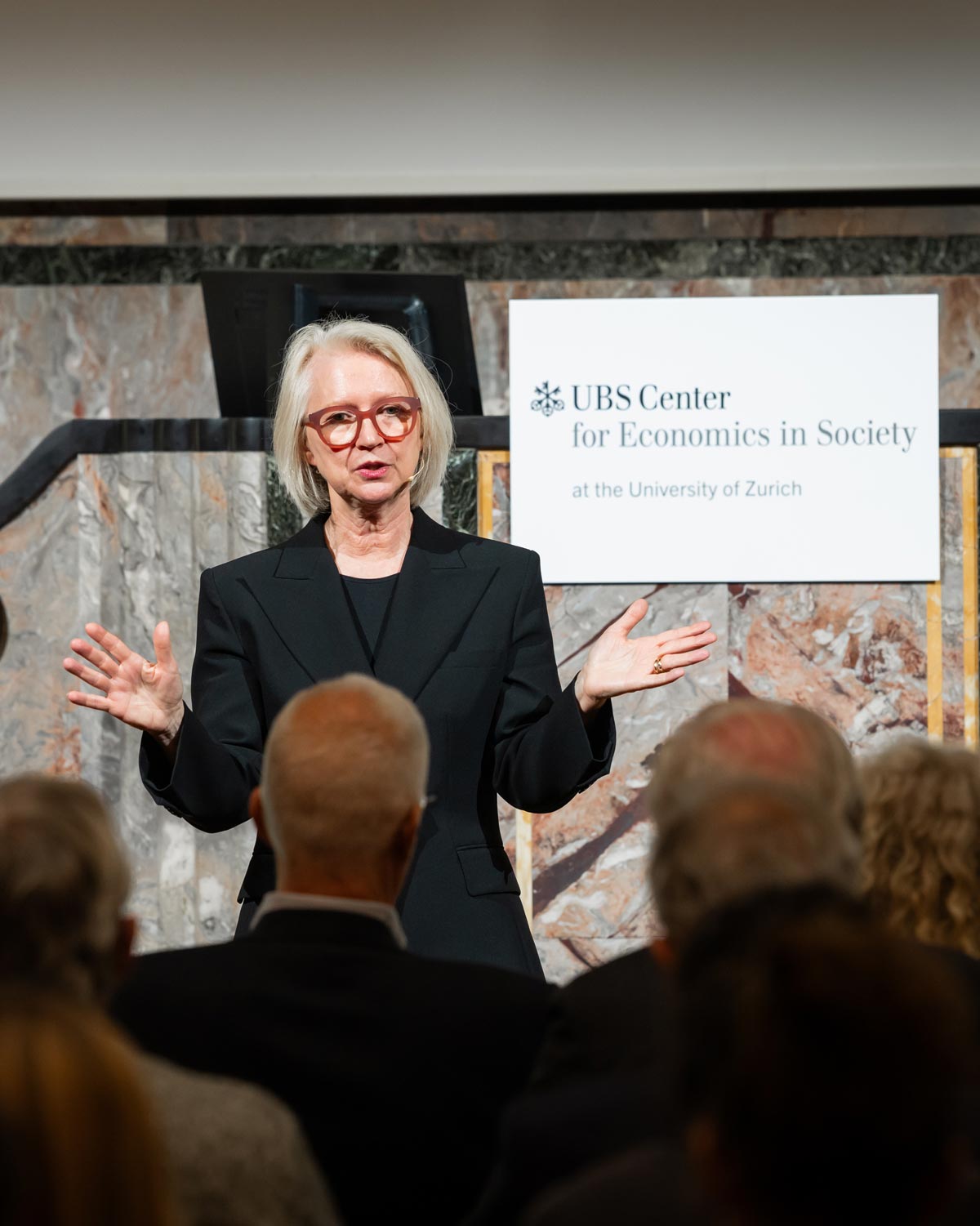
Monika Schnitzer is Professor in Economics and holds the Chair for Comparative Economics at the Ludwig-Maximilians-University of Munich. Professor Schnitzer`s main research interests are innovation, competition policy and multinational firms. She is chairwoman of the German Council of Economic Experts (Sachverständigenrat zur Begutachtung der gesamtwirtschaftlichen Entwicklung – „Wirtschaftsweise“) since 2022 and council member since 2020.
Monika Schnitzer is Professor in Economics and holds the Chair for Comparative Economics at the Ludwig-Maximilians-University of Munich. Professor Schnitzer`s main research interests are innovation, competition policy and multinational firms. She is chairwoman of the German Council of Economic Experts (Sachverständigenrat zur Begutachtung der gesamtwirtschaftlichen Entwicklung – „Wirtschaftsweise“) since 2022 and council member since 2020.