

"Artificial intelligence dramatically exacerbates inequality."
Jul 2026
Jump directly to
Jump directly to
This interview by Simon Schmid was originally published in Tages-Anzeiger on 25.6.2026 in German. Translated and edited for context purposes by the UBS Center.
Ulrike Malmendier is no longer a member of the German Council of Economic Experts, a panel that advises the federal government on economic matters. It is said that she was not sufficiently “market-oriented”. Or perhaps she was simply too much of a thorn in their sides.
One thing is certain: the economist, who moved to the U.S. nearly thirty years ago to pursue a career at Harvard, Stanford, and Berkeley, does not shy away from sharp criticism of economic policy.
We met with Malmendier in Zurich to discuss the major economic challenges of our time.
Ms. Malmendier, you live and conduct research in Berkeley, right next to Silicon Valley. How do you view Switzerland?
As a European living in the U.S., I’m concerned that Europe will be crushed like a grain of sand in the storm between the U.S. and China. In that regard, I regret a little that Switzerland is not aligning itself more closely with the EU—it would make both sides stronger. On the other hand, Switzerland also serves as a role model for the EU.
In what way?
Take digitalization, for example. While the EU is creating a dense web of regulations in this area, major tech companies like Google—with their AI teams—are drawn to Switzerland precisely for that reason.
What must Europe do to produce more companies like these?
American and Chinese AI companies have developed with a strong consumer focus—see ChatGPT. However, they lack the in-depth, valuable data from industrialized nations like Germany or France. Our strength lies in feeding AI models directly with this real-world production data. Companies like Siemens are already tackling this, but policymakers must not stifle this progress through overregulation. We need to build data centers while carefully balancing environmental concerns.
What is ultimately more important: having these data centers in our own countries or applying AI productively on a broad scale?
That question hasn’t been answered yet. But I suspect that, in the end, most money will be made by optimizing industrial processes. No major AI company has yet proven that its business model is sustainably profitable.
Will AI make many workers redundant?
Possibly—but that is a blessing in times of a shrinking population and labor shortages.
What about the people who lose their jobs?
These life-changing upheavals worry me greatly indeed. When years of education suddenly become worthless because of AI, it completely upends people’s life plans. That creates profound disorientation. We’ve seen this in the U.S., in the rust belt or the former coal-mining regions. Even during German reunification, people working in state-owned enterprises were often overlooked rather than included. This leads to bitter pessimism and fuels political polarization.
How should we respond to this?
Those who lose their jobs usually receive financial assistance from the welfare state or retraining. But the feeling of total powerlessness destroys people’s mental and physical health. We know from neuroscientific research that early involvement in predictable changes and a genuine say in the matter are the only effective antidotes to this. We must restore people’s sense that their voice matters.
Who is responsible here?
First and foremost, the companies. When a giant like Volkswagen in Wolfsburg—where families have proudly built internal combustion engines for generations—switches production to batteries, it cannot simply say, “Tough luck, the factory is closing; go get retrained.” Companies must bring workers on board much earlier, ask them for their own ideas, and give them a sense of control back.
The reality is often quite different.
There are also good examples: The Pennsylvania state government investigated how AI can streamline bureaucratic processes. Instead of forcing the technology on personnel overnight, officials were given a relaxed period to simply play around with the tool. Employees developed ideas, felt taken seriously, and viewed the change as positive.
How much of the wealth generated by companies like OpenAI or SpaceX actually ends up with ordinary Americans?
Not much. Tech entrepreneurs benefit disproportionately, and the social divide continues to widen. There’s another factor at play: The ability to use AI fluently will determine professional success in the future. People from higher social classes with better education are adapting to this change well. Those who already come from a less privileged background are falling behind. AI is dramatically exacerbating inequality.
Donald Trump is heavily investing in AI—but also in tariffs, fossil fuels, and low immigration. Is this a recipe for success?
No. Tariffs harm U.S. companies because they make raw materials and intermediate products more expensive. The return to fossil fuels is also short-sighted, as the Iran War has painfully demonstrated. There is no alternative to diversifying energy sources, even for an oil-producing country like the U.S. However, the U.S. will shoot itself in the foot most severely with its restrictive immigration policy. The country thrives on the fact that the world’s brightest minds flock there and drive the economy forward with visionary ideas. If you now make work visas more expensive for skilled workers or deny them altogether, you’re choking off the engine.
How heavily does Europe rely on immigration?
Even more so. One of the main reasons why the German economy, for example, is stagnating is the lack of labor. We simply lack the hours worked. We can try to increase women’s labor force participation or raise the retirement age, but that won’t be enough. We have no choice but to rely on targeted immigration. Parties that advocate the opposite completely misjudge the gravity of the situation following the retirement of the baby boomers.
The EU wants to take a tougher stance against China. Is this justified?
In export-oriented Germany in particular, we have traditionally been skeptical of protectionism. But China uses unfair methods. It erects artificial trade barriers, subsidizes, and protects its industry. It deliberately aims for global monopolies. This is where the logic of the market economy reaches its limits.
Many EU politicians are now calling for tariffs. When Trump did that last year, people in Europe still scoffed at the idea.
Times have definitely changed quickly. China used to be a fantastic market. Trade fueled growth on both sides. Now China threatens to crush us.
Should Europe specifically promote key industries?
It’s not just China—the U.S. is also pursuing a hard line industrial policy. The Biden administration has already tried to force semiconductor production back onto American soil with billions of dollars in funding. In doing so, they were willing to accept certain bad investments. When I talk to people in the administration in Washington, they often laugh their heads off at us Europeans because we still believe that the markets will regulate everything on their own. Europe urgently needs more strategic thinking to secure its sovereignty. To do so, however, we don’t need to copy China’s planned economy; rather, we must remain in close dialog with the markets. Otherwise, we will end up with a level of overproduction similar to that which China currently faces.
Will the U.S., Europe, and China isolate themselves even further from one another in the future?
No one can predict that. That is precisely why Europeans—including Switzerland and the United Kingdom—should devote all their energy to boosting trade within their own continent. We have a rules-based, peaceful, and reliable system here. Nevertheless, every country still erects subtle barriers to protect its domestic industry. If we break down these barriers, especially in the service sector, we will generate enormous benefits.
This interview by Simon Schmid was originally published in Tages-Anzeiger on 25.6.2026 in German. Translated and edited for context purposes by the UBS Center.
Ulrike Malmendier is no longer a member of the German Council of Economic Experts, a panel that advises the federal government on economic matters. It is said that she was not sufficiently “market-oriented”. Or perhaps she was simply too much of a thorn in their sides.
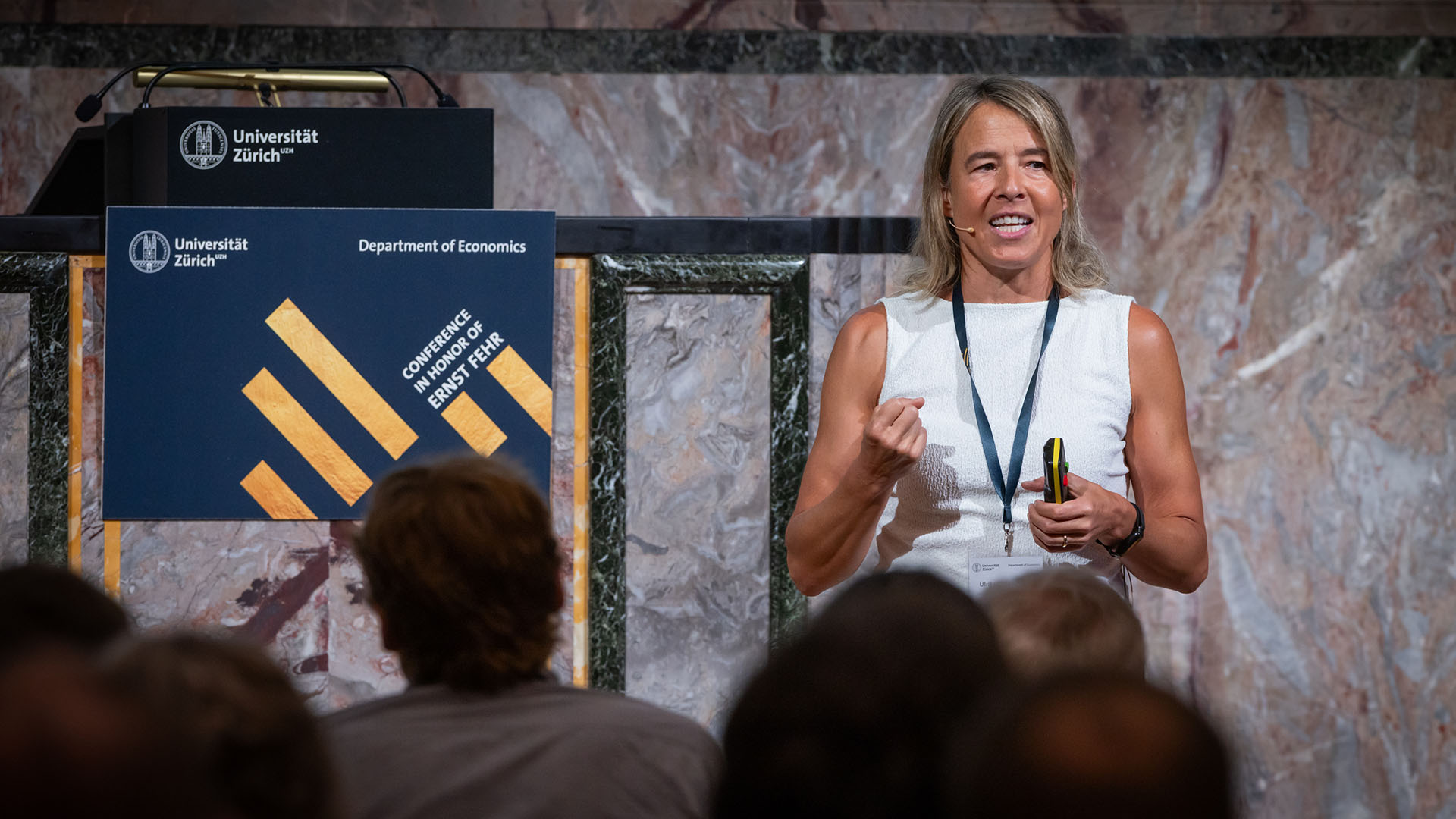

Ernst Fehr has always seen what others missed – the connections between disciplines, the institutions that research needs to thrive, and the partnerships that make lasting impact possible. As he celebrates his 70th birthday, the UBS Center takes this as an opportunity to highlight a career that has shaped behavioral economics as a field, and Zurich’s Department of Economics as a world-class institution. Explore a selection of work, conversations, and tributes that reflect the breadth of his contribution.
Ernst Fehr has always seen what others missed – the connections between disciplines, the institutions that research needs to thrive, and the partnerships that make lasting impact possible. As he celebrates his 70th birthday, the UBS Center takes this as an opportunity to highlight a career that has shaped behavioral economics as a field, and Zurich’s Department of Economics as a world-class institution. Explore a selection of work, conversations, and tributes that reflect the breadth of his contribution.

Ulrike Malmendier is the Edward J. and Mollie Arnold Professor of Finance at the Haas School of Business and Professor of Economics at the University of California. Her research interests are corporate finance, behavioral economics/behavioral finance, economics of organizations, contract theory, law and economics, law and finance. In 2013, Malmendier was awarded the prestigious Fisher Black Prize from the American Finance Association, given biennially to the top financial scholar under the age of 40. She has been a member of the German Council of Economic Experts since September 2022.
Ulrike Malmendier is the Edward J. and Mollie Arnold Professor of Finance at the Haas School of Business and Professor of Economics at the University of California. Her research interests are corporate finance, behavioral economics/behavioral finance, economics of organizations, contract theory, law and economics, law and finance. In 2013, Malmendier was awarded the prestigious Fisher Black Prize from the American Finance Association, given biennially to the top financial scholar under the age of 40. She has been a member of the German Council of Economic Experts since September 2022.