

Shaping economics and economists
Jul 2026
Jump directly to
Jump directly to
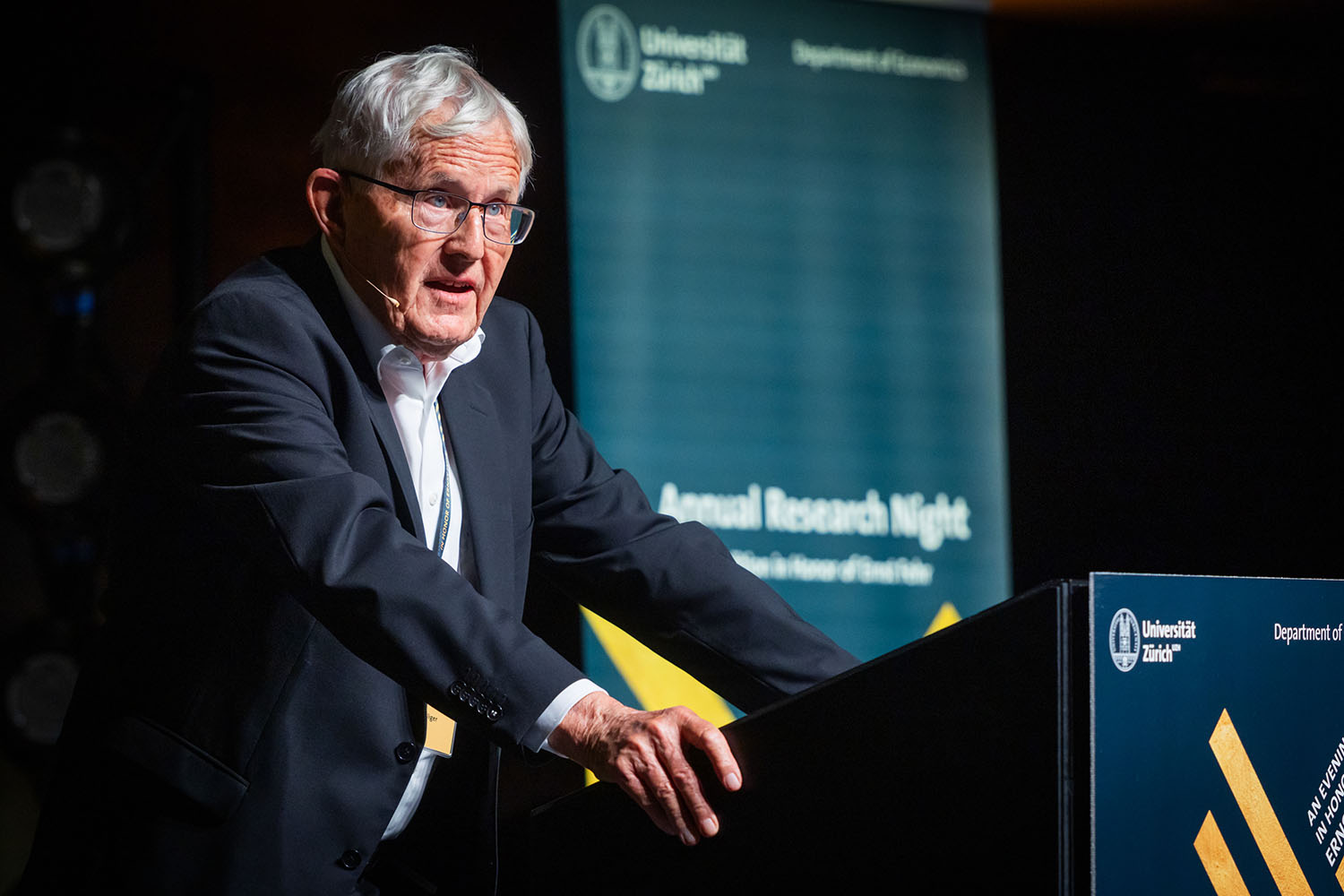
Dear Ernst,
Ladies and Gentlemen,
As a student at ETH, I was interested in everything except politics and economics. My training program for officers was an intensive course in leadership skills. The true faces of the soldiers emerged especially under stress, whether they were egoists, altruists, or conditional altruists, and phenomena like cooperation, reciprocity, and trust suddenly became important, even though I hadn’t yet even heard words like “reciprocity” or “conditional altruist”. I didn’t meet any “homo economicus,” and I was still not interested in economics.
I had to run a business at an early age, and my initial hunches about the importance of institutions and framework conditions soon crystallized into certainties. The law of supply and demand pressed me relentlessly, as creating demand proved far more difficult than generating supply. My interest in economics began to grow. I didn’t encounter many “homo economicus” figures in the industry either. Finally, during my time as finance minister, my earlier disinterest in economics came back to haunt me. Tax policy, monetary policy, fiscal policy, or the debt brake: everything turned out to be economics. I began studying economics textbooks over and over again in my spare time. These volumes were teeming with homines oeconomici, but few of them were politicians, at least as far as rational behavior was concerned.
When it came to optimizing self-interest, you could occasionally find one or two. Finally, at the bank, everything was economics as well, and there I found living homines oeconomici who combined rationality with self-interest.
Then I met Ernst Fehr. He bundled everything I had gathered in life as practical experience into logical economic and psychological frameworks. He demonstrated how crucial cultural and ethical factors are alongside institutions and supplemented the admittedly useful fictional construct of the homo oeconomicus with the complex, versatile, and emotionally driven real-world human being. Thus, at the end of my professional career, I learned many things I wish I had known at its very beginning. Indeed, if I had met a professor like Ernst Fehr after my baccalaureate, who knows, maybe I would have even studied economics.
Of course, I underestimated Ernst Fehr at first. He usually speaks softly and embodies kindness, often accompanied by a gentle, slightly melancholic smile. When he encounters an obstacle, he initially sidesteps it smoothly, but then approaches it again from a different angle, almost unnoticed, if necessary multiple times, iteratively so to speak, persistently, until the obstacle is overcome. So, after our first conversation, it was only in hindsight that I realized he had already nearly wrested 100 million in endowment funds from me as Chairman of UBS. I soon learned that behind his façade of amiable gentleness lies an unyielding will with clear objectives.
The secret of his success is based on the combination of several outstanding qualities, which I will only sketch briefly. Foremost is undoubtedly his exceptional achievement as a researcher. It is the fruit of a never-fading intellectual curiosity, impressive clarity in thought and argumentation, and hard work. Time and again, he had the courage to leave well-trodden paths and venture into unknown territory, making use of methodological innovations. For instance, he was able to prove that fairness, reciprocity, and social norms significantly influence human behavior in markets, organizations, and society. The focus here was not just on institutions, but also on culture in the sense of unwritten yet widely accepted beliefs, values, norms, and behavioral standards. He thus became a leading pioneer of behavioral economics.
The enormous resonance of his research is reflected, for example, in the fact that 44 of his papers alone have appeared in the "top 5 journals" of the economics profession, or that his 1999 "Theory of Fairness, Competition, and Cooperation" achieved no fewer than 17,000 citations. The fact that he received numerous awards - including no fewer than seven honorary doctorates! - is almost a given considering his outstanding achievements. It is no coincidence that two major German language newspapers, the NZZ and FAZ, have voted him one of the most influential economists in the German-speaking world on multiple occasions. Of course, he also repeatedly received prestigious offers from renowned universities such as Oxford, Cambridge, Princeton, and Berkeley. But what makes us all particularly proud is that he has remained loyal to Zurich from 1994 until today. Thank you, Ernst! Mr. President van der Bellen, let me also express my heartfelt thanks to you for allowing Ernst Fehr to emigrate from Austria to Switzerland all those years ago.
In this respect, Ernst joins the long line of immigrants who have contributed enormously to Switzerland’s success—from the Huguenots, the Lombard bankers, the French pharmacists, and the German liberals to entrepreneurs such as Brown, Boveri, Nestlé, and Hayek.
It was precisely this contribution that the Swiss people acknowledged last Sunday when they rejected a popular initiative that sought to cap our population. This, of course, also leaves the way open for Switzerland eventually to surpass Austria’s population as well!
And while I am at it, I should not forget that there are immigrants among us here today whose presence we are equally delighted to celebrate.
Yet Ernst did not remain the detached researcher driven solely by his own ego. His contributions to the public good were just as important. He was always aware that teaching, that is, passing on his knowledge to the next generation of academics, was of fundamental importance. He is, in fact, a gifted teacher who consistently inspires his students - one whom they have voted the best lecturer of the semester on multiple occasions. No less important is his role as a mentor of emerging talent. The list of his former students who have become prominent professors in his field is impressive.
Ernst Fehr also possesses a quality that is of great importance to the UBS Center and to the University of Zurich in general. I call it “reputational gravity.” Thanks to Ernst’s excellent reputation, the UBS Center and the Department of Economics at the University of Zurich have consistently been able to attract outstanding professors. I was also impressed that, with just a few phone calls, he managed to recruit renowned Nobel laureates to the UBS Center’s Advisory Board. Currently, there are no fewer than eight of them!
We must also not forget another significant quality today: that of the structural modernizer. Building the department into a leading international institution would not have been possible if Ernst had not decisively driven its modernization forward by breaking up outdated structures, pooling resources, implementing a strategic appointment policy, and expanding structured graduate programs. This generated quite a bit of headwind. But despite his gentle smile, he pushed it through relentlessly.
Without another important quality, I would not be standing before you today. Ernst is a gifted fundraiser. He wasn’t quite as good as I was in my prime, though. But there is a major difference: he had to win people over to donate through persuasion, whereas I, as Finance Minister, could do so by law.
Anyone who is permanently surrounded by fundraisers, who have almost become a plague these days, will think carefully about where a donation is worthwhile and where it is not. As I mentioned at the beginning, Ernst Fehr really knew how to charm me back then. But of course: when he presented his financial ideas to me with the tongue of an angel, it did take my breath away for a moment. However, the Board of Directors showed immediate readiness to invest one hundred million Swiss francs into the UBS Center, in the meantime, it has grown to around 130 million, as a generous gesture toward the state that courageously supported UBS during the crisis. The condition was to create something of lasting value for the country, without regard to any potential benefit for the bank itself. The enthusiasm in the Executive Board was less pronounced, but Sergio Ermotti pushed it through.
Today, we can note with satisfaction that the Center, and with it the Department, have garnered an enormous reputation. I had the privilege of accompanying this development for about ten years as President of the Foundation. This allowed me to follow Ernst's magnificent work up close. From this, a friendship has developed that I would not want to miss.
Dear Ernst! On behalf of all of us, I congratulate you on your milestone birthday and thank you from the bottom of my heart for everything you have given to science, the UBS Center, the University, and thus to the entire country. If you were a statistically normal, average citizen from the middle section of the Gaussian distribution, I would leave it at this expression of gratitude for your first milestone birthday after the state-mandated retirement age and wish you much fulfillment and joy on long walks or on the golf course.
But since your aforementioned intellectual curiosity is by no means extinguished despite your advancing years, and your brain cells continue to enjoy a delightful level of activity, my tribute to your achievements is by no means a final assessment, but merely an interim one. I thank you in advance for all that is yet to come. We look forward to it.
On behalf of all of us, we wish you many more years full of health, creativity, and joy! In today's thanks, I would like to include your wife and your entire family, who provide you with the solid foundation from which you can deliver your achievements for the benefit of science and the country.
Dear Ernst,
Ladies and Gentlemen,
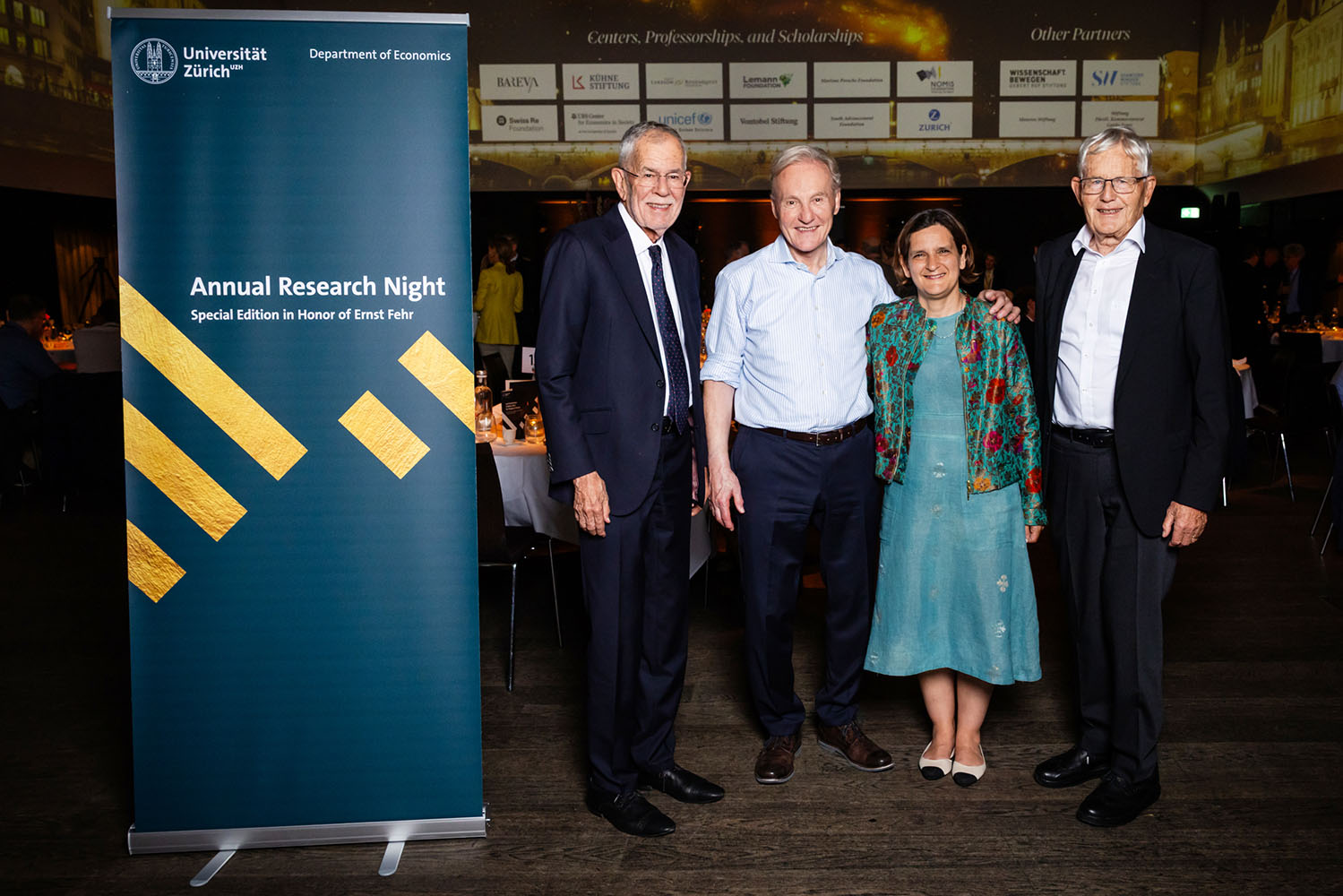
Ernst Fehr has always seen what others missed – the connections between disciplines, the institutions that research needs to thrive, and the partnerships that make lasting impact possible. As he celebrates his 70th birthday, the UBS Center takes this as an opportunity to highlight a career that has shaped behavioral economics as a field, and Zurich’s Department of Economics as a world-class institution. Explore a selection of work, conversations, and tributes that reflect the breadth of his contribution.
Ernst Fehr has always seen what others missed – the connections between disciplines, the institutions that research needs to thrive, and the partnerships that make lasting impact possible. As he celebrates his 70th birthday, the UBS Center takes this as an opportunity to highlight a career that has shaped behavioral economics as a field, and Zurich’s Department of Economics as a world-class institution. Explore a selection of work, conversations, and tributes that reflect the breadth of his contribution.
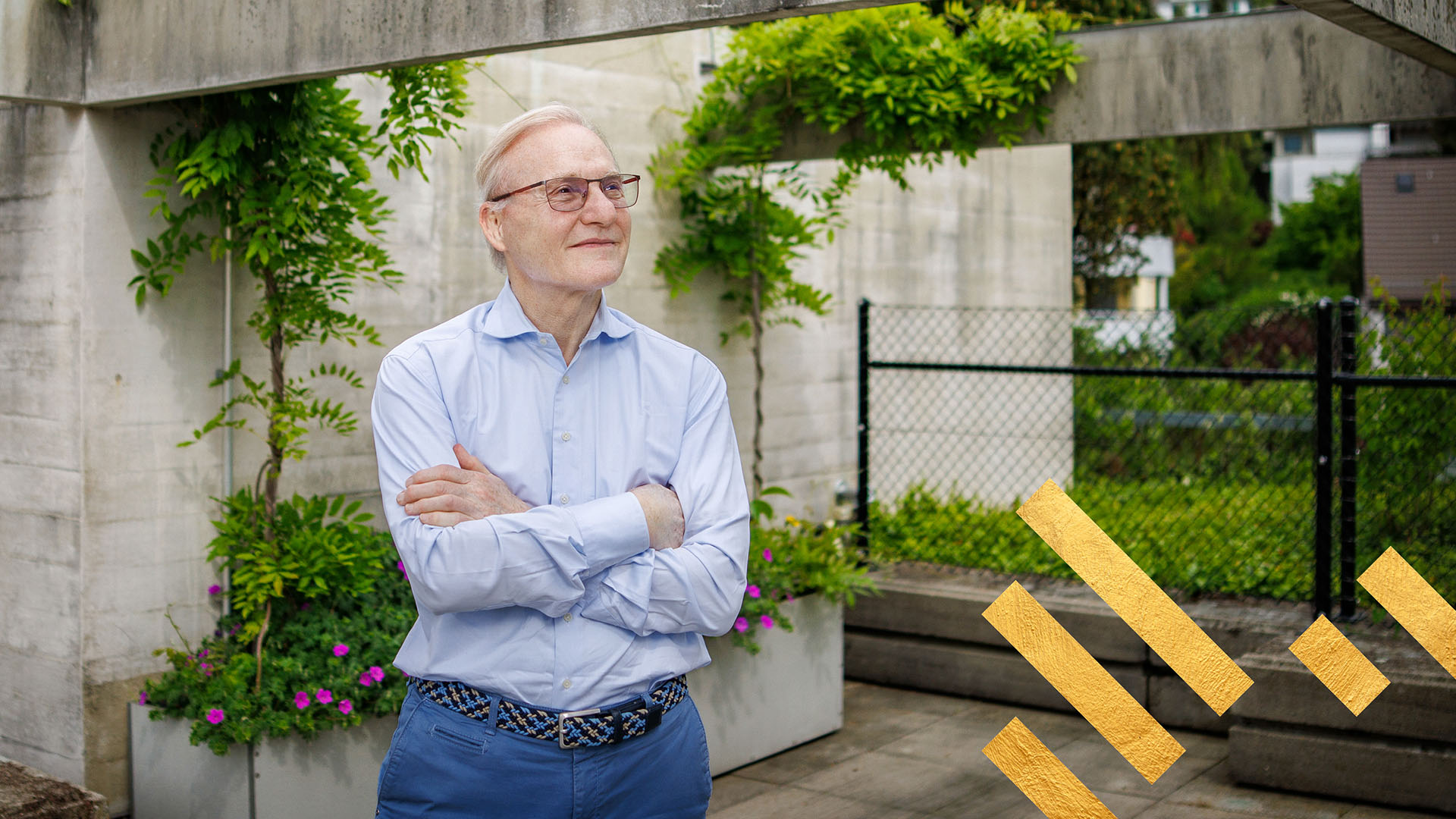
Kaspar Villiger is a Swiss businessman, politician and former member of the Swiss Federal Council (1989 – 2003), serving first as Minister of Defence and then as Minister of Finance. He was President of the Confederation twice, in 1995 and again in 2002. On April 15, 2009, he was elected Chairman of the Board of UBS, holding this post until May 3, 2012. Villiger is a member of the Global Leadership Foundation, an organization which works to promote good governance around the world. In 2012 he became Chairman of the new UBS Foundation of Economics in Society.
Kaspar Villiger is a Swiss businessman, politician and former member of the Swiss Federal Council (1989 – 2003), serving first as Minister of Defence and then as Minister of Finance. He was President of the Confederation twice, in 1995 and again in 2002. On April 15, 2009, he was elected Chairman of the Board of UBS, holding this post until May 3, 2012. Villiger is a member of the Global Leadership Foundation, an organization which works to promote good governance around the world. In 2012 he became Chairman of the new UBS Foundation of Economics in Society.