
"We are at the dawn of a new global financial order"
Dec 2025
Jump directly to
Jump directly to
This interview by Simon Schmid originally published in Tages-Anzeiger on 23.11.2025 in German. Translated and edited for context purposes by the UBS Center.
After US President Trump announced high tariffs on “Liberation Day”, something unusual happened on the financial market: investors fled the dollar and were reluctant to continue lending money to the US. Since then, an exciting theory has been circulating: that America has gambled away its good reputation and could lose its central position in the financial system. Hélène Rey is a researcher at London Business School. The French economist speaks of a decisive moment. She explains what is at stake and why Europe must respond in this interview.
Will 2025 be a turning point in financial history?
Possibly yes. If Donald Trump remains in power and stays the course, fundamental things will change.
In what way?
We will then be at the dawn of a new global financial order. Or rather, a financial disorder – a system without a clear reserve currency, without uniform rules, and with greater susceptibility to crisis. Institutions such as the International Monetary Fund and the US Federal Reserve would find it more difficult to perform their stabilizing function.
What does the current order look like?
The system is based on the dollar. The American currency is omnipresent – whether in banking, on the financial markets, in commodity trading, or as a reserve currency for central banks. The system is efficient and promotes international trade. The US Federal Reserve acts as a lender of last resort in times of crisis.
How will Trump's policies change this?
The US president is fueling doubts about whether the United States can continue to fulfill this role. His attacks on institutions are undermining confidence in the US economy and the US dollar.
What attacks are we talking about?
Primarily those on the Federal Reserve and the judiciary. If the impression takes hold that politics increasing dominate the US central bank and that it can no longer shape its monetary policy independently, this will pose a major risk of inflation. And if corruption in the economy increases, legal uncertainty will rise. Investors around the world will then think very carefully about whether they want to continue investing their money in the US – or whether they would rather take it elsewhere.
Would the dollar continue to lose value in this case?
Exactly. But the attacks on the Fed and its staff are not the only problem. The politicization of the courts, pressure on universities, cuts in research budgets, restrictive immigration policies, denial of climate change, unrestrained borrowing, and, of course, tariffs: these all destabilize the US economy and its long-term growth.
However, the US economy is holding up quite well.
This is mainly due to the AI boom, which is currently driving growth almost single-handedly. The associated investments are also attracting foreign funds. If AI stocks slump, the dollar will lose value – as it did after the announcement of tariffs on Liberation Day.
Can the euro benefit from this?
Not in the sense that it will suddenly replace the dollar as the reserve currency. But the European single currency has the potential to play a greater role internationally.
What would be needed to achieve this?
Greater integration in the European Economic Area. More uniform rules are needed, especially in the financial sector. In the US, for example, there is a large market for government and corporate bonds. In the eurozone, each country borrows separately. This fragmentation is a hindrance. Joint euro government bonds would be much more attractive from an investor's perspective.
How would eurozone countries benefit?
Lower financing costs. This would be particularly useful in times of crisis. Investors would not shy away from the euro – on the contrary, the euro would be in demand as a safe haven, similar to the dollar up to now. Another advantage would be that more capital would be available for start-ups and growth companies. There is a shortage in this area. In addition, it would give Europe more geopolitical weight.
Experts have been saying for years that a banking union, integrated capital markets, and Eurobonds are needed. Why is nothing happening?
It's not that nothing is happening. But it's happening too slowly – and only when a crisis forces politicians to act. The founding father of Europe, Jean Monnet, already foresaw this dynamic: “Europe will be forged in crises and will be the sum of the solutions adopted for these crises.”
Does the current global situation justify a further step toward integration in the spirit of Jean Monnet?
Europe is in the midst of an existential crisis. Pressure is mounting on all sides: Russia is waging a hybrid war against Europe. Meanwhile, the US and China are using their trade policies as weapons to extract political concessions from the EU – knowing full well that Europe's military power is limited.
Do politicians understand the seriousness of the situation?
I'm not sure. Politicians and parties need to do more to inform citizens about the need for action.
Your home country, France, is being viewed with increasing skepticism on the financial markets. Will it become a stumbling block for Europe?
I don't believe France will trigger the next crisis. The economy is not doing so badly. The country has more of a political problem. France needs to get its budget in order and not give in to populism.
France's national deficit is huge – and its debt is very high. Under these circumstances, Germany will never agree to mutualize the debt.
Debt is high in many countries, including the US. However, the EU does not need a complete fiscal union as a first step. It would already help if the EU countries were to raise joint funds on a selective basis, primarily in the area of defense.
Some economists consider the euro to be a flawed construct.
This view was particularly widespread in the US before the eurozone was established. There, people thought that the monetary union would not be sustainable and would soon collapse. They were wrong.
Really? During the crisis, the monetary union almost collapsed.
Yes, but only almost. Abolishing the euro would be fatal from today's perspective. Then there would be twenty different currencies in Europe again. The EU would be vulnerable to crises and could be pushed around even more easily by the major powers. The European Union and the euro are great achievements. They have played a central role in securing peace in Europe for more than 70 years. The single currency makes us stronger and more resilient. In today's hostile world, it is more important than ever.
Does the euro also make Switzerland strong?
What is good for Europe is also good for Switzerland. It is a small country and, in a world where geopolitical risks are increasing, it can benefit from its proximity to the EU. And, of course, Switzerland also helps the European bloc.
Is the euro the only currency that can replace the dollar?
The renminbi will also play a greater role in the future. But it will take a while for China to evolve from a trading power to a financial power. The country severely restricts cross-border capital movements and wants to keep the exchange rate under tight control. This stands in the way of the renminbi's internationalization for the foreseeable future.
So what will the future global financial order look like?
It will be a multipolar order with different reserve currencies and spheres of financial influence – but without a benevolent actor at the center to stabilize the system.
Would that really be so bad?
If all the major powers were to cooperate with good intentions, it would not be so bad. But in the real world of the 21st century, rival blocs are facing off against each other. Geopolitical considerations will overlap with economic arrangements. This will bring additional complexity, efficiency losses, and unpredictability to the system. The financial architecture will be more confusing than before.
This interview by Simon Schmid originally published in Tages-Anzeiger on 23.11.2025 in German. Translated and edited for context purposes by the UBS Center.
After US President Trump announced high tariffs on “Liberation Day”, something unusual happened on the financial market: investors fled the dollar and were reluctant to continue lending money to the US. Since then, an exciting theory has been circulating: that America has gambled away its good reputation and could lose its central position in the financial system. Hélène Rey is a researcher at London Business School. The French economist speaks of a decisive moment. She explains what is at stake and why Europe must respond in this interview.
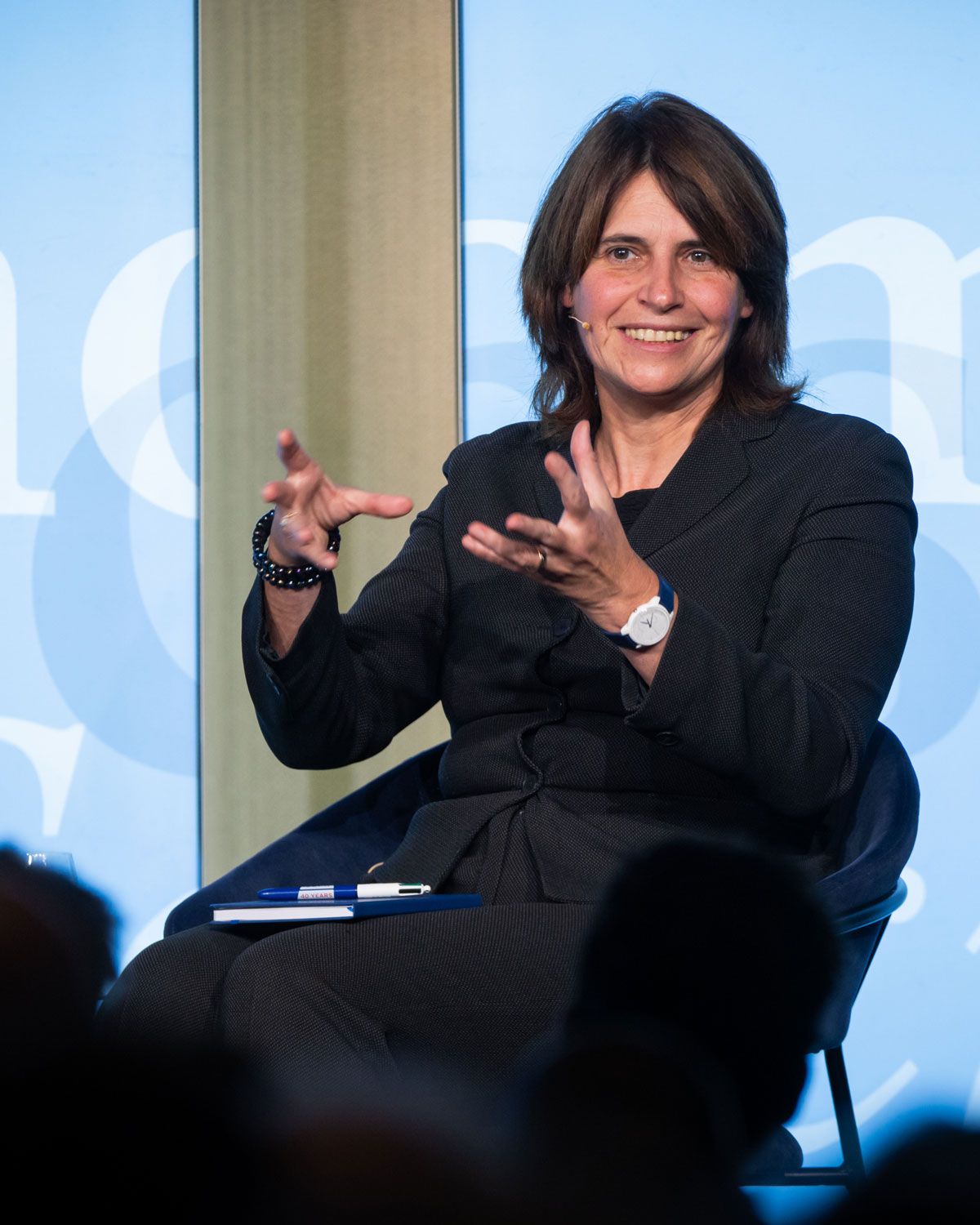
Hélène Rey is the Lord Bagri Professor of Economics at London Business School and a leading expert in international macroeconomics and finance. Her influential research focuses on global financial cycles, exchange rates, and the international monetary system. She previously taught at Princeton University and the London School of Economics, and her work appears in top academic journals. Rey is a Fellow of the British Academy, the Econometric Society, and the American Academy of Arts and Sciences, and has received numerous prestigious prizes. She serves as Vice-President of CEPR, co-editor of the Annual Review of Economics, and advises institutions including the IMF and the French government. Rey holds degrees from ENSAE Paris, Stanford, LSE, and EHESS.
Hélène Rey is the Lord Bagri Professor of Economics at London Business School and a leading expert in international macroeconomics and finance. Her influential research focuses on global financial cycles, exchange rates, and the international monetary system. She previously taught at Princeton University and the London School of Economics, and her work appears in top academic journals. Rey is a Fellow of the British Academy, the Econometric Society, and the American Academy of Arts and Sciences, and has received numerous prestigious prizes. She serves as Vice-President of CEPR, co-editor of the Annual Review of Economics, and advises institutions including the IMF and the French government. Rey holds degrees from ENSAE Paris, Stanford, LSE, and EHESS.